

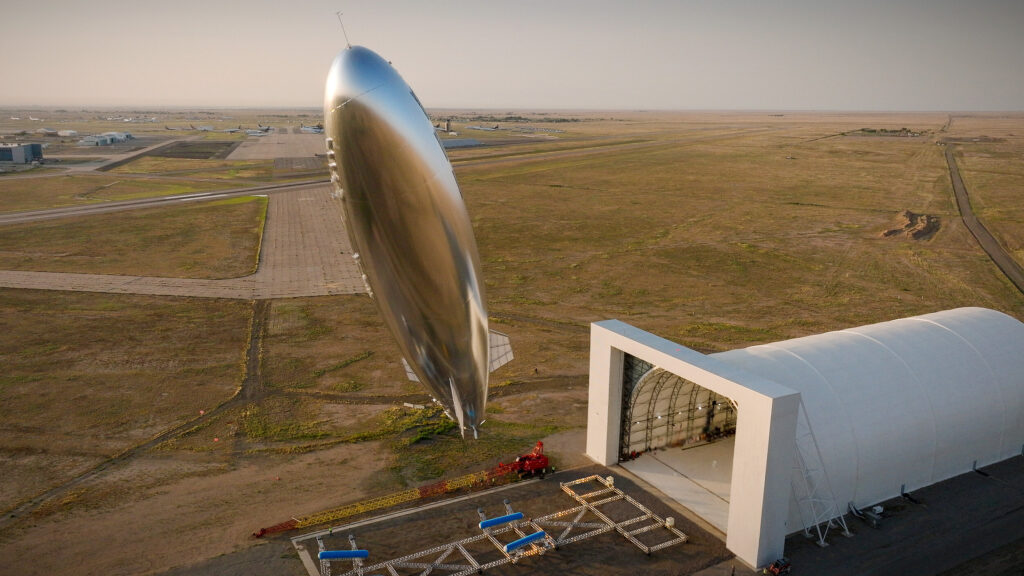
An interesting update on HAPS – which might ring bells if you have your head in the trenches with private 5G, on the horizon with physical AI, or in the clouds with D2D, or you just happen to be looking for the next hair-brained networking fad. Except this could be more than that, if Softbank’s latest pre-commercial tests of high-altitude platform stations (HAPS) with US-based aerospace and material science company Sceye are anything to go by. The Japanese telco, its fingers in just about every innovation seam in every layer of the tech stack, says it has demonstrated common-or-garden smartphone comms from a blimp-style airship 20 kilometers above Japan – including voice calls, text messages, video streams, plus disaster alerts and maritime calls.
More than that, it fixed the platform within a five-kilometer radius of its terrestrial target area, despite stratospheric winds – and put a mobile core and a web server on board the aircraft to boot. As a consequence, Softbank reckons it recorded a round-trip latency of 68 milliseconds for traffic processed through the onboard edge – more than 40 percent lower than equivalent internet traffic routed via the cloud. The trial also linked the HAPS to drones, allowing remote flight control, location tracking, and video transmission. Which is a lot of stuff, right there – and makes HAPS look less like an eccentric alternative to Starlink et al and more like a missing layer in the new network stack, with terrestrial RAN below, LEO satellites above, and edge computing somewhere in the stratosphere. More here…

James Blackman
Executive Editor
RCR Wireless News
RCR Top Stories
HAPS takes flight: Softbank’s latest HAPS trial suggests the stratosphere could become more than a way to fill coverage gaps – potentially combining wide-area cellular, private networks, drones, and edge computing in one airborne platform.
AT&T inference: AT&T is betting AI inference will create network opportunities as compute moves closer to users, machines, and enterprise sites, requiring dense fiber and 5G to link distributed AI workloads with the data they generate.
6G takes shape: ITU and 3GPP are turning 6G from a collection of industry ambitions into an implementable system, defining performance requirements, radio architecture, and foundational tech while preserving 5G investments.
IoT value drive: LoRaWAN has answered the question of whether LPWAN can work at scale. With deployments spanning applications and industries, the focus is now shifting to where its economics can deliver the greatest IoT value.
Packaging plant: SK Hynix is putting $4bn into an HBM4E packaging plant in Indiana – its first US mass-production base – while warning also that the AI memory crunch will run through 2030.

AI-Powered Telecom Infrastructure
Supermicro, in collaboration with NVIDIA, delivers AI-powered infrastructure tailored for telcos, enhancing operational efficiency, network management, and customer experiences. Explore now
Beyond the Headlines
Fiber bottleneck: AI inference and agentic workloads will drive demand for high-speed fiber, but power constraints, longer deployment timelines, and uncertain returns on new routes complicate infrastructure expansion, says KPMG
Private fabrics: Verizon and Lumen have billion-dollar fiber deals with hyperscalers and AI firms as the build-out of distributed AI creates new demand for purpose-built networks and reshapes the economics of carrier investment.
6G in AI infra: Qualcomm sees 6G as the connectivity fabric linking distributed compute across devices, RAN, edge, and data centers, as AI pushes intelligence and workloads across the continuum.
6G connects compute: Qualcomm sees 6G as the connectivity fabric linking distributed compute across devices, RAN, edge, and data centers, as AI pushes intelligence and workloads across the continuum.
AT&T AI model: AT&T’s OTel 2.0 is live in production – a 31bn-parameter telecom model trained on 430 AMD Instinct GPUs, with Dell servers handling on-premise inference.
What We're Reading
Underground 5G: A look at Boldyn’s neutral-host installation on the London Underground, with all four major operators using its shared 4G and 5G network, and Ookla data showing how the long-delayed rollout performs in real-world use.
Dragonwing launches: Qualcomm is expanding its Dragonwing portfolio with Q-2390 and IQ-2390 processors, bringing AI, vision, connectivity and security to a broader range of consumer, commercial and industrial IoT devices.
Nokia R&D center: Nokia has opened an R&D center in Riyadh focused on AI-powered network automation, developing software that can help communications networks configure, optimize and repair themselves while reducing energy use.
Kajeet sells p5G unit: Kajeet has sold its private 4G/5G services and integration business to Heddian, which will take over customers and deployment services – while Kajeet sharpens focus on Sentinel, its private 5G orchestration platform.
Sci-fi kids in charge: Silicon Valley’s sci-fi fixation has produced a dangerous misreading of its warnings about tech, with the likes of Musk, Thiel, and Altman treating dystopian futures as blueprints rather than cautionary tales.