

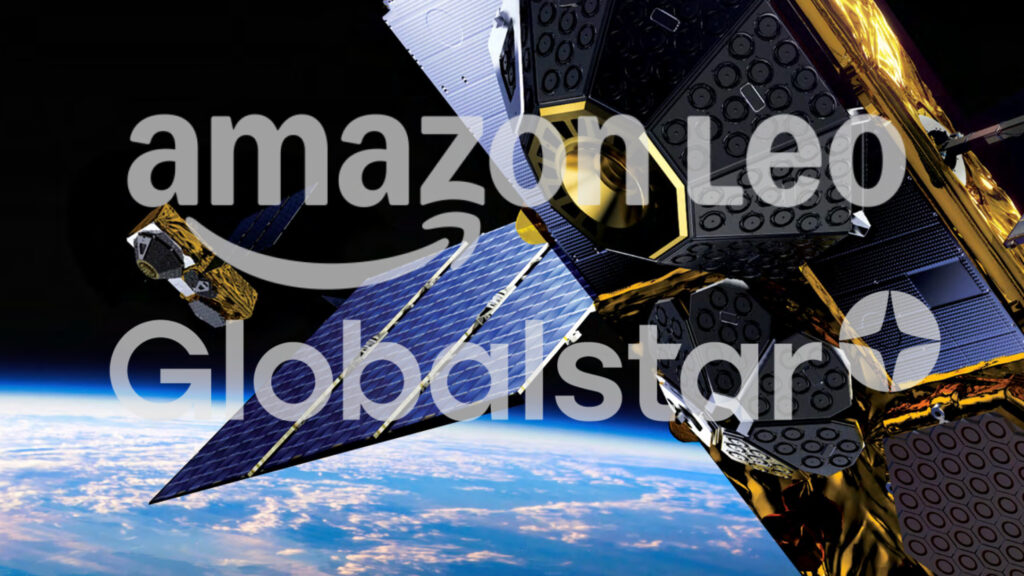
So, we have some familiar talking points today, based on new news and views. Let’s start with the satellite stuff. The FCC has approved Amazon Leo’s $11.5bn purchase of Globalstar, announced in April, based on a review by its space bureau of the proposed transfer of 25 MHz of MSS spectrum as part of the deal. The move bolsters the tech conglomerate’s start-up space business, ostensibly to take the fight to Starlink. Amazon Leo has nearly 400 satellites in orbit; Starlink has 11,000. It filed with the FCC in July to deploy 5,105 new D2D satellites to use Globalstar’s spectrum. (The FCC has just approved SpaceX to deploy 15,000, and AST SpaceMobile to deploy 248).
The Globalstar package includes two dozen satellites, with approved plans for 54. But the deal – scheduled to close in 2027, and likely the early part – is about spectrum, really. SpaceX agreed to buy 50 MHz of spectrum from EchoStar in late 2025, approved by the FCC in May, across the AWS-4 and H-block bands, plus up to 15 MHz of AWS-3 spectrum – for a total of up to 65 MHz – in a deal worth $19.6bn; it has since agreed to buy up to 14 MHz of paired spectrum in the 800 MHz band from Grain Management for around $8bn. A crude price-per-MHz comparison makes Globalstar look expensive: about $460m per MHz, against about $300m for the complete EchoStar holdings.
But the bands are different, and come with different assets and terms. Globalstar brings a satellite network, okay, but also regulatory authorizations and a deal with Apple to connect its phones and watches, including for SOS calls. Apple invested about $1.5bn in Globalstar in 2024 in return for a 20% equity stake. Amazon will pick up the stake, and maintain the service. Also, the FCC has separately authorized Globalstar to operate a new 48-satellite network (C-3 System) in the US using specific uplink/downlink D2D bands (1610-1618.725 MHz and 2483.5-2500 MHz, plus others (5091-5250 MHz, 6875-7055 MHz) for comms channels with ground stations and control links to spacecraft. It all puts a premium on ground infra.
AT&T has signed as a distribution channel for Amazon Leo in the US; SpaceX, of course, is busy (talking about) building a terrestrial network to turn its D2D extensions into a full-blown carrier service – upsetting the big US telcos along the way. The FCC sounded an “aggressive” note itself, with a view to free-up more D2D spectrum. Tomorrow (October 29), it will vote to auction the 1675-95 MHz and 2020-2025 MHz bands, and also to open up 500 MHz of additional spectrum. Brendan Carr, chairman at the FCC, called the Amazon Lee authorization a “significant step towards supercharging next-generation connectivity”.
The other talking point is about 6G monetization, but we are out of time. So I’d just recall that RCR wrote (reported) way back in 2018 that 5G might be considered a testbed for 6G (Whisper it: is 5G the new 3G? – ran the headline), and also commend Christian’s write-up of a discussion with BT and Ericsson at 6G Forum about drone sensing (ISAC) and robots (or physical AI) as the likeliest money-spinners for this next-gen mobile tech – and ask: were we right about the testbed, and haven’t we seen this movie before?
A longer version of this article is available here.

James Blackman
Executive Editor
RCR Wireless News
RCR Top Stories
6G money making: 6G revenue will start rolling in with ISAC and physical AI – not speed, said a panel comprising BT, Ericsson, and Keysight at 6G Forum. Business cases come before the build – and Release 21 will land after LA28.
Gbps mmWave FWA: Verizon is to scale a new 1 Gbps FWA service using millimeter-wave spectrum, targeting 10-15 million additional premises alongside its stated target to pass 40-50 million premises with fiber.
Boldyn’s big bet: Value comes from controlling infra – cables, sites, power – and not by betting just on wireless tech, says Boldyn. The firm is prioritizing owner-funded converged networks, and is cautious on private 5G, open RAN, NTN.
Quarterly questions: Orange, AT&T, and Verizon are improving earnings via commercial growth and cost discipline, while telcos place bets on AI infra and physical AI. But will today’s gains translate to tomorrow’s growth?
Token economy: AI is shifting from a model economy to a token economy, putting new demands on infra. As inferencing and agents spread across locations, telcos must connect distributed compute and intelligence securely and efficiently.

AI-Powered Telecom Infrastructure
Supermicro, in collaboration with NVIDIA, delivers AI-powered infrastructure tailored for telcos, enhancing operational efficiency, network management, and customer experiences. Explore now
Beyond the Headlines
Urgent 6G rethink: Verizon CTO Yago Tenorio says 6G needs an architectural rethink to handle AI-driven uplink demand, avoid repeating 5G’s mistakes, and embed autonomous network operations and commercial use cases from the outset.
Crown tower push: Crown Castle says mobile data growth, spectrum investment, and potential new wireless entrants like SpaceX are supporting the long-term outlook for US tower infrastructure.
No shortcut, no deal: Verizon has raised its guidance for the third consecutive quarter, signed $4bn in AI infra deals and delivered a fierce warning to SpaceX: building a terrestrial network offers no magic wand, secret sauce, or shortcut.
Bullish on AI-RAN: Nvidia and Nokia have declared progress with AI-RAN – a year after Nvidia pumped a billion into the Finnish firm. The roll call is impressive: T-Mobile, Deutsche Telekom, Orange, Elisa, BT, plus nine EMEA telcos.
Network economics: AI agents will shift work from customer devices to distributed computing networks, changing where data travels, how capacity is used, and which providers control routing, connectivity, and the economics of AI infra.
What We're Reading
Globalstar green-light: The FCC has approved Amazon Leo’s $11.5bn deal for Globalstar, clearing the way to combine satellite infra and 25MHz of spectrum to expand D2D connectivity, emergency comms, and rural coverage.
Bell tower sale: Bell Canada (BCE) will sell a 49.9% stake in its tower business to La Caisse for C$2.45bn, valuing the company at C$4.91bn. Bell retains control of more than 5,000 sites, freeing capital for debt reduction and growth.
Factory expansion: NTT Data has expanded its AI Factory network to four global locations, helping enterprises test AI workloads, infrastructure, security, and costs. New facilities in Paris and Singapore join existing sites in Texas and Riyadh.
Robot to edge AI: 60 GHz wireless between humanoids and edge AI servers is closer, as a Peraso demo sustained 500 Mbps uplink and 100 Mbps downlink connectivity for transfer of sensor, video, and telemetry data.
Voluntary buyouts: Microsoft is offering voluntary buyouts to 60,000 staff, or more than a quarter of its workforce, as it seeks to control costs and fund major AI investments, including a forecast $175 billion in 2026 capital expenditure.
Latest RCRtv Interviews
Events
Industrial Wireless Forum, November 10th, Virtual
From private 5G, Wi-Fi and public cellular to edge AI, spectrum, next-generation IoT and sensing, the forum examines the infrastructure choices and practical challenges shaping the future of industrial operations. Register now
AI Infrastructure Forum, December 8th, Virtual
Join RCRTech’s AI Infrastructure Forum to explore how telcos, hyperscalers and data centres can compete or partner as AI shifts to inference, and who captures the value when every token counts. Register now
Industry Resources
RCRTech Trend
Rise of Non-Terrestrial Networks (NTN)