

Table of Contents
The summit’s rhetoric around AI-driven economic and military supremacy conceals dual-path strategies
In sum, what to know:
- U.S. leads in advanced GPUs and frontier models: The U.S. controls roughly 75% of global GPU cluster capacity, compared to 15% for China.
- U.S. tech outspends Chinese by 10-to-1: Hyperscalers are set to deploy more than $650 billion in AI capital expenditures for AI research and physical infrastructure.
- Open-source ecosystems and labs: DeepSeek and Alibaba have aggressively closed the technical performance gap between U.S. and Chinese models to under 3% now.
- Rare earths and supply chains: China’s highly centralized economic model dominates both global manufacturing supply chains and the rare earth element (REE) market.
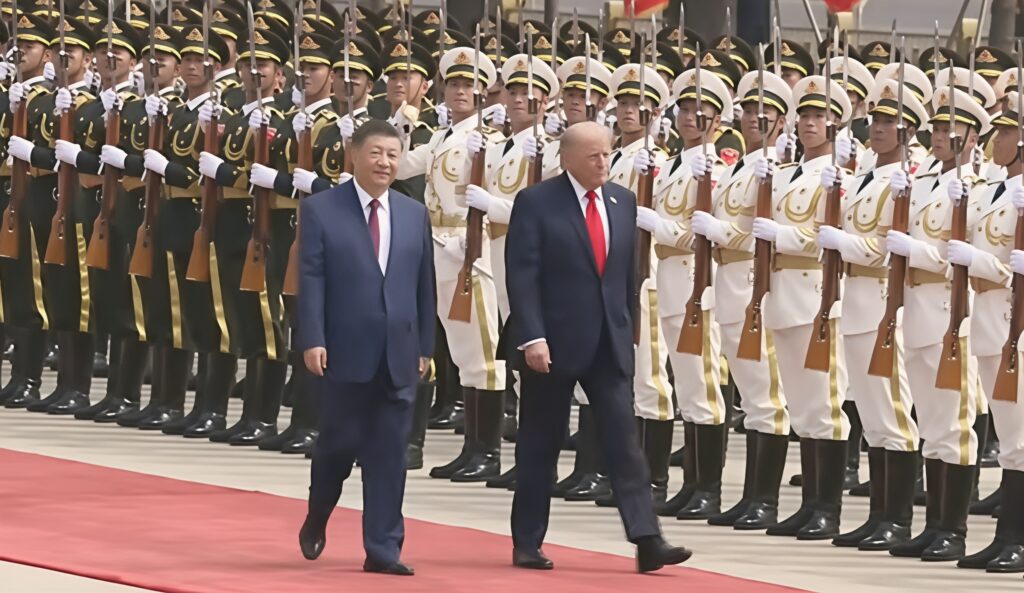
President Trump and his delegation of business leaders, which included 8 tech CEOs, were greeted with a lavish ceremony at the Great Hall of the People, including a 21-gun salute, a highly spartan PLA demonstration, and troop inspection.
The flawless execution of its military honor guard was a metaphor to China’s state-driven AI strategy, which is shifting the AI race from a battle of raw compute to one of precision execution. While the United States still has a clear lead in advanced GPUs and training frontier models, China’s state-directed and funded penchant for industrial scaling is closing some gaps. In the recent U.S. – China Economic and Security Review Commission (USCC) research paper, there is recognition and a modicum of concern that China is embedding AI into every aspect of its economy and military, while also luring a range of international and domestic actors.
China’s open-source gambit to publish model source code and weights has accelerated global uptake of Chinese AI, also generating a feedback loop in which widespread adoption drives iteration and further adoption.
China’s “interlocking innovation flywheels” across sectors is enabling low-cost AI deployment en masse across factories, logistics networks, and robotics firms—generating real-world data that feeds back into model improvement. Some say that creates a compounding advantage of widespread physical deployment, with real-world industrial data feeding and refining China’s AI models.
Will that be enough to bypass China’s current compute constraints? Alibaba’s Qwen models’ tens-of-thousands of derivatives have become a widely deployed open-source answer to American closed-source options, like OpenAI and Anthropic. With thousands of global developers choosing open source, it’s possible China will close the capabilities gap, despite having less computing power.
A Closer Look
While China excels at scaling production and manufacturing, the U.S. still has command over AI chips, as with Nvidia’s Blackwell and Rubin architectures, and increasingly, AMD’s accelerators, which we examined more closely yesterday.
China’s chips, primarily Huawei’s Ascend, are far less powerful than U.S. chips, which means U.S. restrictions on advanced chips, and on advanced lithography, are hurting China. The Chinese workaround for these handicaps is a more software-based, 90%-10% open-source approach that is less “brute force” and more finesse in using small, specialized neural pathways for queries to cut down on processing needs, and to operate at much lower costs. But even with those workarounds, the U.S. still has a firm hold on cluster-scale, GW muscle in compute and sheer data center count.
As of publishing, the U.S. hosts 5,427 operational data centers– roughly 45% of the world’s total of 12,000+ facilities.China has approximately 449 operational facilities, though many of those are massive-scale localized sites, with a state-sponsored ability to rapidly electrical generation capacity.
- United States: McKinsey & Company forecasts the U.S. will need approximately 80 GW of dedicated annual data center capacity by 2030, whereas Goldman Sachs puts the estimate closer to 122 GW of data center capacity.
- China: ~40 GW total capacity, with AI and HPC making up 39% of that total, which Beijing says will surpass 60 GW by 2030 (28 GW of pipeline projects officially announced.
When it comes to capex, U.S. tech outspends Chinese tech 10-to-1 for AI research and physical infrastructure. According to Morgan Stanley, U.S. corporate AI investments total more than $109 billion annually, which eclipses the Capex of the rest of the world, combined.
Jacobs recently said that by 2030, there will be $7 trillion in data center investments in the U.S., with “traditional data centers turning into AI factories.”
All in all, the U.S. command over GW-scale infrastructure and advanced architecture remains profound. Whether China’s open-source dominance will be enough to make it an AI superpower remains to be seen. It has the lever of the physical supply chain of rare earth elements (REEs) and high-performance permanent magnets, which are critical to high-tech manufacturing and GW-scale data centers. Metals like neodymium, dysprosium, praseodymium, and terbium are required to regulate heat, spin storage drives, clean power grids, and actuate physical robotic limbs.
Another lever for China is its supply chain for electrical gear including transformers, switchgear, and commercial batteries needed by U.S. data center and power suppliers.
These levers, plus its open-source dominance, are speeding China’s trajectory toward technological self-sufficiency. That could give it a commercial advantage over time, similar to its Android strategy, which captured the global mobile market for smartphones by offering a free alternative to Apple’s iOS.
In fact, U.S. export controls on Nvidia and AMD chips are succeeding in accelerating China’s push for self-sufficiency, which could draw other nations into its orbit – especially if efficiency becomes more coveted than scale. While American companies are heavily focused on scale and Artificial General Intelligence (AGI), Chinese developers are focusing on reducing operational costs, and creating cheaper, highly practical, and commercially viable AI models.
With all of these factors in play, perhaps it makes sense to think beyond a single AI “superpower,” instead thinking of the U.S. and China as an AI duopoly, with the U.S. leading in advanced, high-impact AI models and hardware, and China leading in AI application, manufacturing, and publication volume.
