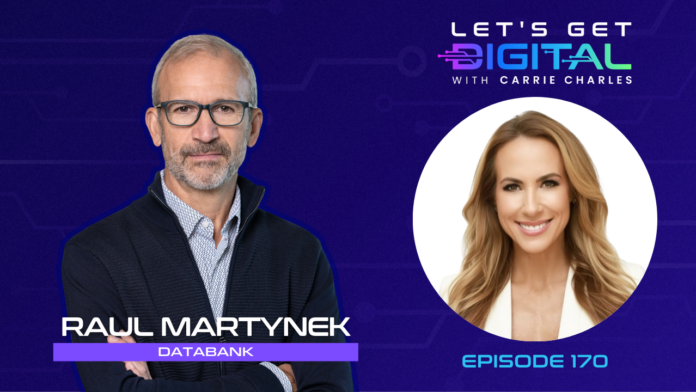
00:00 Ready to explore the cutting edge of digital infrastructure? I'm Carrie 00:04 Charles, your host of Let's Get Digital. Join me as we dive into the ideas, 00:09 technologies, and leaders transforming the way we connect from wireless telecom 00:14 to fiber networks, [music] data centers, and beyond. Sponsored by Broadstaff in 00:19 partnership with RCR Wireless News. [music] 00:21 Now, let's dive in and let's get digital. 00:26 Thank you for joining me today again on Let's Get Digital. [music] I am glad 00:30 you're here. We have an exciting episode for you today. Someone I respect 00:34 immensely and I've known for many years. It is Raul Martin. He is the CEO of 00:40 Datab Bank, a fast growing, very [music] fast growing data center and cloud 00:44 infrastructure company helping power the digital economy and the rapid rise of 00:50 AI. Ro, thank you for being here again. [laughter] 00:55 Thank you for having me. Great to be here. 00:57 >> So, Ro, I had you on the show. This was years ago. So, I really wanted you to 01:01 come back on. There's been a lot happening in your space and just talk 01:06 about it a bit, give us some ideas of the future and, you know, let us see 01:10 into your crystal ball a bit. But first, we want to hear about you. So, please 01:15 tell us a little bit about your journey and how you got to your seat. 01:19 >> Sure. Well, I won't uh go too long because I've been in the space a long 01:23 time. So it is a long story but no I've been fortunate to be in kind of digital 01:27 infrastructure for the last 30 years you know got in at the advent of the 01:32 commercial internet you know in the mid '9s you know at the time obviously the 01:36 internet was just emerging you know data centers were not a thing and it was 01:40 about telecom right so like a lot of folks that started back then I started 01:43 in telecom and uh it was a entrepreneurial business it was a what 01:48 was called the seac it was in the northeast and you know it was the dot 01:52 era so we were able to you grow the business and raise uh institutional 01:56 capital in 1999. That was my first kind of experience with institutional 02:00 capital. So since then, you know, I've been fortunate enough to go from telecom 02:05 to to fiber to cloud and then over the last 15 years or so into data centers, 02:11 all you know, always working with sponsors, you know, building businesses 02:15 in the space and then, you know, got the data bank, which is where obviously 02:18 where I'm currently at about 10 years ago at this point, which is kind of 02:22 crazy. You know, I knew Marky from Digital Bridge and at the time, you 02:26 know, Digital Bridge was an emerging platform. They were looking to invest in 02:30 data center businesses and given my experience there, Mark asked me to join, 02:34 which I did and, you know, we ended up acquiring datab bank in 2016 when it 02:40 was, you know, six data centers in three markets. So, you know, over the last, 02:44 you know, almost 10 years, we've been able to grow it to, you know, be one of 02:47 the largest data center businesses in the US. So, it's been, you know, an 02:51 incredible uh journey. So tell me more about datab bank. 02:54 >> Yeah, so look, we're a data center operator and developer, you know, 02:57 focused here in the US. You know, today we have the largest geographic uh 03:01 footprint of data centers in the US. In other words, we're in more markets than 03:06 anyone else. It's a very, you know, important factor from my perspective 03:10 because, you know, when customers make a decision around, you know, where to put 03:14 their IT assets, where to colllocate, geography typically is one of the top 03:19 criteria, right? So if you the way I look at it is you know we're in more 03:23 geographies which basically means we have more opportunities to solve 03:27 customer needs and you know that's been a big part of our success having this 03:32 very large geographic reach coupled with you know the ability to invest in 03:37 meaningful size uh data centers which we have been over the last couple years. 03:41 >> So the data center space has changed a lot over the last you know five years 03:46 even. Sure. >> Tell me what has changed in your view 03:51 and also how have you navigated some of these challenges? 03:54 >> Yeah, you know, it's really interesting just looking at how it's changed just 03:58 you know while I've been here at datab bank. So when I got here in 2016, you 04:02 know, the data center space, it was obviously very well established. In 04:06 fact, at the time there was, you know, five public companies, but when you 04:10 actually look at like the size of those companies, they were all relatively 04:13 small, right? Equinex was like a two billion a year business you know switch 04:18 and corite and Cyrus ones were you know 300 to $500 million a year businesses 04:24 right and datab bank was a $50 million business right so again the sector 04:29 overall was relatively small and back then you know ultimately you know 04:35 customers obviously same product right same you know form factor a data center 04:40 but you know their needs were just incredibly smaller right You know, I 04:44 remember when we did our underwriting for DFW3, which was, you know, going to 04:49 be our largest data center at the time in 2016, it was going to be a, you know, 04:54 a 10 megawatt data center. And people were like hand ringing over like, are we 04:59 going to be able to sell that capacity? And, you know, at the time, you know, if 05:03 you could get a 1 megawatt or a 2 megawatt deal, it was considered, you 05:07 know, just massive and everyone was super excited, right? And really, that's 05:11 been the big change. You fast forward to today and you know the requirements have 05:16 just gotten just you know enormous you know 10x 20x 100x of what you know back 05:21 in 2016 so that's I think been the biggest change in the sector is just 05:26 kind of the the scale of it has gotten just increasingly larger you know 05:31 obviously you know that was happening through you know 201 you know 1516 05:36 through call it you know pre- AI you still had you know these increasing 05:41 requires irements and then you know AI showed up in 2023 and that's kind of you 05:46 know step functioned it uh higher in terms of the size requirements right you 05:52 know enterprise deals in 2015 like I said were one or two megawws you know 05:57 hypers scale deals back then if it was a big one might be 10 megawws or 20 06:02 megawws you know you fast forward to today and you know we have enterprise 06:06 deals that are you know 20 or 30 megawws and then you got you know hypers scale 06:10 deals that are, you know, 250 megawws to a gigawatt, right? So, that's kind of 06:16 really been the evolution of the space and obviously why, you know, it's 06:20 become, you know, front and center in terms of people's minds. 06:23 >> Has it been challenging for you to adapt to all of this insane growth and these 06:28 changes? >> Yeah, listen, you know, anytime you grow 06:31 a business, you know, from where we started to now, there's always going to 06:35 be, you know, scaling challenges, right? You know, look, it has been nine years, 06:40 too. So, you know, it's been somewhat of a not, you know, gradual, but you know, 06:44 rapid type of of, you know, growth. You know, I think, you know, two things on 06:48 that. You know, the hardest things are, you know, obviously attracting, you 06:52 know, good talent into the organization because people are the foundation of 06:56 your business and as you need to, you know, get more and more people, you 07:00 know, that becomes harder and harder, especially to maintain the quality of 07:03 that. Number two, you know, just execution and kind of customer 07:08 experience becomes harder as you scale out these businesses. You know, you have 07:12 a lot more, you know, layers of management in a business. So, you know, 07:17 the execs are less connected to what's happening on the ground and you have to 07:21 figure out a way to, you know, make sure to ensure that you don't lose that 07:25 connectivity with the customer experience. And then the third and you 07:29 know, really challenging piece is capital, right? I mean we bought the 07:33 business in 2016 you know the entire we bought the entire business for 320 07:38 million at the time which was considered you know a good size transaction you 07:43 know now we're building data centers that a single data center is you know 07:47 500 million of capital right so that's kind of you know the capital aspect has 07:53 become you know one of the real determinants to you know how quickly you 07:58 can grow is the ability to access capital and the ability to access 08:02 capital on favorable terms. >> So obviously there's a lot of hype right 08:06 now for AI, for data centers. I mean I can't even, you know, read anything or 08:11 the Wall Street Journal every day without hearing something about it. So 08:15 is this demand real? Is it durable? I mean, what could derail it? 08:21 >> That's a great question. So I'll start with the your last part of that 08:25 question. Is it durable? It absolutely 100% is durable. Right. My strong view 08:30 is you know the way I describe data centers is you know what is their actual 08:35 function? Their function is to facilitate technology adoption for you 08:40 know humans right for businesses and people right if you think about 08:44 everything on your phone everything on your computer it originates and 08:47 terminates in a data center right so what we've obviously seen over the last 08:52 30 years is this you know insatiable demand to consume technology which means 08:58 that you know that you need more data centers. So my strong view is you know 09:01 10 years from now we're going to need more data centers because humans are 09:06 going to find more and more ways to consume technology adopt technology for 09:10 all the reasons that you know we know about it's for business for 09:14 entertainment for education for communication for you know applications 09:18 all that so there's that kind of macro demand trend and then when you kind of 09:23 peel down or peel back you know that onion you know there's a lot of 09:26 different currents in there right so you know the way I look at the market right 09:30 now is you know and we're in a position where datab bank you know we have this 09:34 large footprint we have 2500 customers so we get to see a lot we have a wide 09:39 range and a wide aperture of kind of visibility into customers consumption of 09:46 technology and you know so I we look at our business you know it's got a big 09:50 enterprise segment right those are all you know fortune 1000 type companies 09:54 down to midsize companies that obviously are 100% dependent on their data their 09:59 applications And that segment of the market we think is really healthy. We're 10:03 seeing enterprises invest in technology adoption, invest in digital 10:07 transformation, invest in hybrid architectures. That's all driving 10:12 enterprise demand. You know, the hyperscalers, you know, obviously 10:16 they're, you know, everyone knows about them now. Everyone knows about their 10:20 growth. you know, for folks that haven't been following it, they just all came 10:24 out and reaffirmed or affirmed what their capex commitments are going to be 10:28 for 2026. And it's staggering, right? You know, you take the top five, six 10:33 hyperscalers and their capital commitments, you know, for 2026 are like 10:38 625 billion up from like 400 billion, 450 billion in 2025. So there's no doubt 10:47 that cohort is going to invest. And then you have the kind of AI companies, 10:53 right? The open AIs, the anthropics, the perplexities, the cursors. And you know, 10:59 Silicon Valley, I saw one stat where Silicon Valley has invested uh $200 11:05 billion in AI startups. So all these companies that are trying to bring, you 11:10 know, LLM based products to market. Well, guess what? They're all consuming 11:15 tokens, consuming GPUs, and that's the part of the market that I think is it's 11:21 nent, right? Because it really started, you know, two and a half years ago, 11:25 three years ago. And those business models are still not 100% proven in 11:30 terms of their ability to, you know, become profitable. So that's kind of the 11:35 part of the market that I think when you read these articles about you know AI 11:39 fears and AI bubbles it's that segment of the market that people are focused 11:44 on. The hyperscalers have real businesses, right? These enterprises 11:49 obviously have real businesses and now you have this kind of new entrance, you 11:53 know, that are trying to form businesses and obviously there's a huge expectation 11:58 that there are going to be winners there, but certainly when you look at 12:02 past trends, you know, not everyone's a winner, right? And ultimately there's 12:06 going to be a bunch of, you know, creative destruction that happens. But I 12:10 think, you know, again, for long-term players who are not looking to 12:14 capitalize on a short-term, you know, euphoria, I think it's a really good 12:18 market to be in and a great market to be in over the long term. 12:22 >> So, it sounds like, you know, the capital is there and willing and able 12:26 and ready. But what are some of the bottlenecks that could prevent these 12:30 data centers from being built? >> Yeah, so there's more and more 12:34 bottlenecks occurring every day. So, you know, yeah, the capital's there, but 12:39 guess what? you know, there is an unlimited capital and you're already 12:42 starting to see that. You know, Oracle had some issues in terms of, you know, 12:46 being able to, you know, continue to lease capacity in the marketplace and 12:51 they obviously it was a two weeks ago, I think, that they came out with a $50 12:55 billion debt and equity, you know, raise that they're going to enact over the 12:59 next, you know, year or so. So, so you're starting to see even, you know, 13:02 at the scale that we're talking about, you know, the financial system, you 13:06 know, can't digest all that capital. So I I do think access to capital is going 13:11 to be a constraint for people that I think that you know as we continue to 13:16 you know march forward that it will become more and more scrutinized over 13:20 what investments get made. So I think that's going to be one. Obviously you 13:25 know we still are in a situation where power is a regulator of capacity. Um I 13:31 mean there's a lot of capacity that is being leased. You know, last year the 13:36 estimates are it was a record year that there was, you know, call it 14 13:41 gigawatts of data center capacity that was leased in 2025. 13:47 I will guarantee you that all 14 gawatts of that, they had a very clear pathway 13:53 to power. You wouldn't be leasing data center capacity either as a developer or 13:59 as a customer if you weren't 100% convinced that there was a pathway to 14:03 power there. Right. So, so yes, there's a bottleneck around power, but obviously 14:07 the evidence shows that the industry is figuring that out, but that's continue 14:12 to be somewhat of a regulator. And then the third one is, you know, rising costs 14:18 and lead times, right? You know, obviously with all this demand, the cost 14:22 to build data centers is going up. So, that's putting more pressure on people 14:26 in terms of is it justified? And then you know as a function of that what 14:31 we're seeing is an increasing amount of community opposition to data centers 14:37 right I'm sitting uh today in New York and New York uh recently there's a bill 14:42 that got introduced in the at the state senate level that would put a three-year 14:46 you know moratorum on data centers as they understand their full impact to 14:51 electrical prices and to environmental issues and you know what I think that's 14:55 misguided but it's an example of kind of the reaction 14:59 that is happening from the population in terms of push back on new data center 15:05 developments and this is happening in red states and in blue states right this 15:10 is not you know limited to a particular area you got some significant push back 15:15 in Northern Virginia uh with a number of projects that have been kind of you know 15:19 derailed and Chicago you know so there's a this is going to be it's going to 15:24 become increasingly harder to build because of the capital because of the 15:29 supply chain, because of community push back and because of power. But that's, 15:34 you know, in our view that's a bad thing and but also a good thing, right? 15:38 Because ultimately, you know, our sector is in a healthy state from, you know, 15:42 certainly from our perspective because there's a good supply demand balance. 15:47 You know, one thing that we know about, you know, any type of infrastructure 15:51 sector is it's supply and demand that ultimately dictates, you know, how good 15:55 it is for the people that are in it. And right now it's a good time to be a data 15:59 center developer because you know you have more demand and supply and you have 16:03 these constraints. >> How are you preparing for these 16:05 challenges? >> You know there is such a thing. 16:08 >> Yeah. No no there is no there's no magic bullet. It is purely grinding and it out 16:14 right in all three of these it means that you need to spend more time on 16:18 raising capital. You need to spend more time on your supply chain. You need to 16:22 spend more time and energy and money on community relations and in public 16:27 relations and things like that. And you got to spend more time on, you know, 16:31 securing power and making sure that you have a very multi-year 16:36 type of kind of scope, right? I mean, you know, seven, eight years ago, you 16:41 would think about building a data center and because it was, you know, a 10 16:44 megawatt or 7 megawatt or 12 megawatt data center, you kind of like decided, 16:49 okay, in January, let's go do that. And then you would find a piece of land by 16:54 March or April, and of course, the power was going to be there because there was 16:58 plenty of power at that level. And then, you know, 18 months later, you had a 17:02 data center. right now it's like uh-uh you know right now you know we're buying 17:06 land right now where we think the timeline of power is 2029 2030 17:12 >> but that's the way you have to think right so that's the way ourselves and 17:17 other people in the sector are responding we're just taking a very 17:21 long-term view on things and that's a function of all those kind of you know 17:25 the slowdown that happens through all those constraints that we just talked 17:29 about >> so across the US and also globally Where 17:32 do you see capacity scaling the fastest over the next decade and what 17:39 differentiates markets that win versus again what we talked about some that 17:43 stall? >> Yeah. Well, listen, you know, on a 17:46 global basis, the US is well positioned to continue its leadership role. You 17:51 know, I think it's I think you know 60% I think is the number I've seen of all 17:55 the data center infrastructure in the world is in the US. And you know, the US 18:00 is going to continue to do well, right? Because you know ultimately while 18:04 everyone's complaining about all these issues you know there are things that 18:07 are being done to you know to create new generation to create new distribution to 18:12 increase supply chains to allow for this development to continue. So I think uh 18:17 we're extremely well positioned on a global basis. You know within the US you 18:21 know right now there's you know there's a couple locations that are better 18:25 positioned than others and that is really a function of of power 18:28 availability and the ability to get new power onto the grid. You know, I'm based 18:33 in Dallas and Texas in my view is in a great position to emerge if it keeps 18:38 going to be the number one data center market in the country and surpass you 18:43 know Ashurn and that's because you know Texas has a very can do attitude. It 18:49 also has a unique power situation where the Texas has its own grid. It's called 18:54 the URK grid and it's been streamlined over the last you know decade or more to 19:01 you know facilitate people connecting to the grid and to facilitate distribution 19:06 to to endpoints and investments are being made there by OT and the utilities 19:10 that do that. So I suspect you know a market like Texas is going to do well. 19:15 What you're also seeing as a function of all this demand is locations that you 19:19 know hereto for were not data center locations are becoming data center 19:24 locations. You know you're seeing people build data centers in North Dakota in 19:28 Wyomi in you know Louisiana. You know some of that is being done by the 19:33 hyperscalers who traditionally have done that in the past. you know, where they 19:36 can they have such big needs that satisfy themselves, they can say, "Okay, 19:41 you know what? It's okay if we're in, you know, rural North Carolina and build 19:45 a data center cluster that works for us." You know, people like ourselves, 19:49 you know, given our broad range of customers, you know, my enterprise 19:52 customers, they don't want to go to North Dakota. So, we're not going to go 19:56 there, right? We're going to stay in metro markets. But the AI companies, 20:00 especially the new ones and the GPU as a service companies, you know, they're 20:03 willing to go to those locations to satisfy, you know, their near to demand 20:07 needs. So, I think it's going to be a combination of, you know, some existing 20:11 markets, some new markets that will kind of, you know, emerge over the next, you 20:16 know, 5 to 10 years. And, you know, ultimately, no one really knows how much 20:21 of this infrastructure you need. I think that's a big question. You know, we'll 20:25 find out. If I knew the answer to that, you know, I wouldn't be sitting here. 20:28 >> Very true. So, datab bank has got such an exciting growth story. U looking back 20:34 role. What decisions do you feel have made the biggest difference? It could be 20:39 one decision, it could be two in that growth. And also, it's interesting you 20:44 did decide to stay private versus pursuing an IPO. 20:48 >> Yeah, a couple things come to mind on that. So we've been in a fortunate 20:51 position where you know kind of to your topic there around an IPO or liquidity 20:57 or an exit is that datab bank was originally stood up it was stood up as 21:01 an a separate SPV right so we are not in any fund which in funds you know the way 21:08 they work is people raise money put it into a fund they make investments and 21:12 then there's an end of life where the fund needs to liquidate those 21:16 investments. So, we've been fortunate in that we have an open-ended kind of 21:20 platform where we can continue to bring in capital to grow the business and to 21:26 rotate investors so that we can keep going. And that's been, you know, that 21:30 decision which kind of was purposeful and also kind of situational when it 21:35 happened back in 2016 looking back at it was pivotal for our ability to continue 21:41 to grow as an independent platform. So, that would be one. You know, another one 21:46 would be, you know, we were fortunate to align ourselves with, you know, some 21:49 great investors, right? Digital bridge, of course, as our lead investor, but, 21:54 you know, over the years, we've been able to bring in folks like Swiss Life, 21:57 which is, you know, one of the largest insurance companies in Europe, who've 22:00 been able to support us. In 2024, we raised 2 billion of new equity with 22:06 Australian Super, which is a pension system out of Australia that has, you 22:10 know, a very long-term horizon and deep pockets. So that kind of access to 22:15 capital given the scale of what we talked about was critical. And then 22:19 number three, you know, and really, you know, underpins everything is, you know, 22:23 the people that are in the business, right? I've been fortunate to attract a 22:27 great leadership team, you know, the folks that, you know, I work with on a 22:31 daily basis and then we've been able to attract, you know, just a tremendous 22:35 number of other really great people so that, you know, the business can 22:38 continue to execute, right? One of the stats that we like to tout is that, you 22:43 know, Datab Bank has had 44 quarters of consecutive positive net bookings. So 22:48 that means, you know, for over 10 years, we've consistently grown the business in 22:53 and out of any type of market silo or any type of market disruption. And 22:58 really, we think that is kind of a testament to the quoteunquote machine 23:01 that we've built that can execute regardless of market conditions. And you 23:06 know, knock on wood, we'll continue to do that. And I know how important the 23:10 people aspect is to you role and let's talk about talent for a minute. Where 23:15 are you seeing the workforce shortages? Are you seeing any specific skill sets 23:19 in the data center world that are short now and will get worse coming up? 23:24 >> Yes, I think uh look talent we spend a lot of time on that in two ways. Number 23:29 one, attracting talent but more importantly keeping talent, right? So we 23:34 really work hard to ensure that you know we have a great company culture. You 23:38 know we just got a nomination for one of you know great places to work that was 23:42 you know uh very highly scored in terms of the responses from the employees in 23:47 June of last year. We rolled out a companywide equity program so that every 23:53 datab banker that works at the company has an ability to get a financial stake 23:57 in the business. So you know we're all owners in the business. So those are the 24:01 types of things that we do to try to you know attract keep people with us that 24:05 are you know great people and then on the you know on the new uh higher front 24:10 you know look you're building a lot of data centers and that's the part that's 24:13 really accelerating. So people that are in the construction field and the 24:18 project management field and then people that are in the facilities management 24:22 after you build a data center you have to maintain it all those kind of folks 24:26 are in demand across the country. So those are areas that you know we have to 24:30 really spend a lot of time on and make sure that you know they know who datab 24:34 bank is and that you know we're able to convince them to come join us. 24:38 >> So you talked about datab bank university when we last spoke and I mean 24:43 I think obviously what we all need to do is we have to build our own talent 24:49 >> and that that is crucial to be able to you know to carry out these visions that 24:53 we have. So talk a little bit more about Datab Bankank University. What I guess 24:58 what prompted it? How did you create it and what does it do? 25:00 >> Yeah. So listen, Datab Bank University is really kind of our our online 25:04 training platform to allow people to advance professionally within the 25:08 company, right? and that you know being able to progress your workforce you know 25:13 give them new professional development opportunities an ability to grow 25:17 financially to grow from a managerial perspective is critical to retaining 25:22 people that are ambitious and good and you know a players as we say so so the 25:27 university is kind of the training platform and it really spans all kinds 25:32 of disciplines within datab bank right so what we look at is you know different 25:35 parts of our organization and how do we create a career path for people in that 25:39 organization. You know, one of our largest components of folks is data 25:43 center operations, right? We have a lot of people that are inside these data 25:47 centers caring and feeding for the data centers and for our customers needs. So, 25:51 we have a structured program there where, you know, you come in, you know, 25:55 relatively inexperienced as a DCT1, you know, you can go up to DCT3 and then a 26:01 lead and then from there you can go into managerial positions. So we want to make 26:05 sure that that university underpins their ability to gain new skills and to 26:10 be able to grow along that way. We do that on the sales side. you know, we 26:14 have, you know, over a 100 folks on the sales side and we've been able to, you 26:18 know, now bring in, you know, more kind of greener type of talent that we think 26:23 has the right DNA and be able to bring them into positions like, you know, a 26:27 BDR position, which is a business development rep where they're kind of 26:31 more, you know, cold calling or responding to inbound leads and then 26:35 from there get them to an account management position and then from there 26:38 to kind of more of a national account manager. So and we're seeing some good 26:42 progression there. So it's really about you know trying to create these career 26:47 progressions within your functional groups in the organization and then the 26:51 university is kind of the knowledge that you need to have as you scale up into 26:55 these more higher positions of responsibility. 26:58 >> What is the datab bank way? So the datab bank way is kind of you know our 27:03 cultural cornerstones our leadership behaviors right we have got you know 27:08 years ago actually like in 2018 or 19 you know we really felt like the 27:13 business was not hitting on all cylinders that we had kind of as I like 27:18 to say different tribes within the company you know by definition we're a 27:21 business that is decentralized you know we have a thousand associates but 27:25 they're in 65 different markets and then there's people that are remote how do 27:29 you get such a diverse geographic group that isn't interacting with each other, 27:35 you know, on a day-to-day basis. How do you get them to operate as a single 27:38 team? And the datab bank way is really kind of our cultural, you know, mantras 27:44 that, you know, we instituted in the business and that everyone understands, 27:48 right? And, you know, to give you an example like leadership behaviors, it's, 27:52 you know, that's kind of like, hey, how are we going to agree to interact with 27:56 each other, right? And with our customers, right? So for example, one of 27:59 our leadership behaviors is take extreme ownership, right? It's like if you see 28:03 something, you know, we don't want to hear it's not my job. We want to hear we 28:07 have a problem here and we need to fix it and let's coalesce as a group and fix 28:12 it. Right? We have another one that's called collaborate before you escalate. 28:15 Right? We felt that, you know, back then we were had too much, you know, people 28:19 were peers and they had an issue to resolve but they weren't really trying 28:24 to resolve it. they were just escalating it to their manager and then trying to 28:28 get their managers to resolve it. That doesn't work as you scale. We want to 28:31 push decision making down as much as possible. So, we ended up coming up with 28:35 that. So, it's really a a way it's kind of our own internally developed, you 28:40 know, thought process around, you know, how we're going to operate as a group 28:44 and then how are we going to engage with our customers and our partners so that 28:48 we can, you know, drive a a great business. So last question, if the data 28:53 center industry gets one big decision wrong in the next decade, what do you 28:57 think it will be and what should leaders do now to stay resilient, come out 29:02 stronger regardless of how this growth cycle plays out? 29:06 >> Yeah, that's a good question. I mean I think you know if you look at the data 29:10 center market and you look at kind of some of the es and flows of the data 29:14 center market it goes back to you know what I said earlier which is this is 29:18 fundamentally a business about supply and demand right so you know back to the 29:23 earlier comments there's no doubt in my mind that demand for data centers is 29:27 going to be greater you know there's going to be more data centers 10 years 29:31 from now 15 years from now but you know look in every business cycle there's you 29:35 know it's not a straight line And ultimately, you know, where I think the 29:39 sector could get into trouble is if we end up in a scenario where for whatever 29:44 on some type of short-term or medium-term basis, we end up with a lot 29:48 more supply than there is demand because that it's real estate. It's no different 29:52 than, you know, when you buy a residential house or you're looking for 29:56 commercial office space, you know, when vacancy is low, you know, it's a sellers 30:00 market. And when vacancy is high, it's a buyer market, right? So, and we had 30:05 periods where there was a lot of vacancy in certain markets and you know it was a 30:10 slower dynamic. I mean it's hard to see that right now because of you know kind 30:15 of the craziness going on but you know to expect this to continue forever is 30:19 also I think crazy right so there's going to be some type of correction 30:25 pullback slowdown hard to say when and ultimately you know from my perspective 30:30 you know that's where you got to make good decisions around where you're going 30:34 to develop because it is a real estate business like I said and it's location 30:38 location so that's kind of the way we think about it. Other people have 30:42 different views and hey, it's a free market. People can have different views. 30:46 And then from a leadership perspective, it's, you know, uh, feeling that, you 30:50 know, these businesses are going to get a lot bigger, right? And that, you know, 30:53 ultimately, you know, everyone's going to, you know, we're going to be, you 30:56 know, we're now, you know, north of a billion in revenue and, you know, we're 30:59 going to be multi-billion revenue in 5 years or 10 years, right? So making sure 31:03 that you know we can still scale the business, still maintain that intimacy 31:08 that we want to have with our customers, still create a still have a great 31:12 working environment. That's going to be the challenge over the next 5 to 10 31:15 years. >> Bro, I always enjoy talking to you. I 31:18 always learn a lot and I truly appreciate you coming on the show. This 31:21 has been fantastic. >> Thanks for having me, Carrie. It's great 31:24 to be here. >> I'll see you soon. 31:25 >> Take care. >> Take care. 31:28 >> Thanks for tuning in to Let's Get Digital. This podcast is powered by 31:32 Broadstaff, a national staffing firm specializing in digital infrastructure 31:36 talent. Don't forget to subscribe, leave a review, and join me next time as we 31:41 explore more stories at the intersection of technology, talent, and 31:45 transformation. Until then, let's get digital.
No matching passages. Try another word.