

Table of Contents
AI infrastructure demands massive amounts of energy — is there anything we can do about it?
The race to build more powerful AI models has sparked an energy crisis. While headlines focus on breakthroughs in reasoning and generation, the infrastructure powering these advances is consuming electricity at an unprecedented rate. Training a single large model like GPT-3 can use over 1,200 MWh of energy and emit hundreds of metric tons of CO2, a footprint that compounds with every new iteration and deployment.
Data centers full of GPUs draw massive amounts of power and generate substantial heat, creating a need for advanced cooling systems that consume even more energy. Despite growing commitments to sustainability, many of these facilities still rely predominantly on non-renewable energy sources. The result is an increasingly uncomfortable tension between AI’s promise and its environmental cost.
As models become more capable and inference demand scales globally, the industry will increasingly have to ask the question: how do we ensure that gains in artificial intelligence are worth the environmental price? And what responsibility do AI-driven firms have to be energy-conscious as they push the boundaries of what’s computationally possible?
The scale of AI’s energy demand
Global data center energy consumption was estimated at 240-340 TWh in 2022, accounting for roughly 1-2% of global electricity demand, a footprint comparable to the entire airline industry. In the United States specifically, data centers consumed 4.4% of total electricity in 2023, a figure that’s climbing rapidly as AI workloads expand.
The growth is stark. AI-related server energy consumption rose from 2 TWh in 2017 to 40 TWh in 2023, a twenty-fold increase in six years. U.S. data center electricity demand is projected to range from 325-580 TWh by 2028, representing 6.7% to 12% of total electricity consumption and potentially tripling from current levels.
This exponential growth is driven by increasingly larger generative AI models. Each new generation, from GPT-3 to GPT-4 to GPT-5 and beyond, requires orders of magnitude more computational resources than its predecessors.
Why AI is so energy-intensive
Training large language models involves billions of parameters adjusted through repeated computations, requiring thousands of GPUs running continuously for weeks or months. The hardware demands alone are staggering. Advanced AI-optimized servers equipped with powerful chips consume two to four times more energy than traditional counterparts, and approximately 60% of all data center electricity goes directly to powering the servers processing digital information.
The numbers at the component level are similarly concerning. Between 2007 and 2023, average dual-socket servers drew around 365W. Recent 2023-2024 data shows they now draw 600-750W during active use. While individual servers have improved their idle power consumption to roughly 20% of rated power, the intensity of AI workloads means they rarely sit idle.
Even individual operations carry meaningful costs. Processing a million tokens produces carbon emissions equivalent to driving a gas-powered vehicle 5-20 miles. Creating a single image with generative AI uses the energy equivalent of fully charging a smartphone. These figures may seem modest in isolation, but they compound rapidly across billions of daily queries and generations.
Environmental implications
The environmental footprints obviously extend beyond electricity. AI’s expansion drives significantly higher water usage for cooling, straining local resources in regions with concentrated data center infrastructure. Areas that host multiple large facilities are beginning to feel the pressure on both power grids and water supplies.
The surge in demand will soon overwhelm existing power grids, particularly as the next generation of hyperscale facilities comes online. These upcoming data centers are expected to use 20 times the electricity of typical AI-focused hyperscalers, which already consume as much power as 100,000 households annually. Grid operators in some regions are already struggling to accommodate new capacity requests.
Compounding the problem is the frequency of model retraining. To maintain relevance and accuracy, large models require regular updates, each consuming substantial energy. Infrastructure failures and software inefficiencies add additional strain. And despite corporate sustainability pledges, many data centers still rely predominantly on non-renewable energy sources, meaning that every additional megawatt of AI compute translates directly into increased carbon emissions.
Current solutions
The industry is pursuing efficiency gains across multiple fronts. At the hardware level, power capping has emerged as a straightforward intervention. Limiting processors and GPUs to 60-80% of their total power capacity reduces both consumption and operating temperatures without necessarily sacrificing significant performance.
Better specialized hardware could help too. AI-specific accelerators, neuromorphic chips, and optical processors are all being developed with efficiency as a primary design constraint rather than an afterthought.
Software-level solutions are proving equally important. Dynamic workload management tools like Clover, developed by researchers at MIT and Northeastern University, make carbon intensity a scheduling parameter. These systems automatically detect peak energy periods and make intelligent adjustments, such as routing queries to lower-quality models or reduced-performance compute during high-carbon windows. In testing, Clover achieved an 80-90% reduction in carbon intensity for different types of operations.
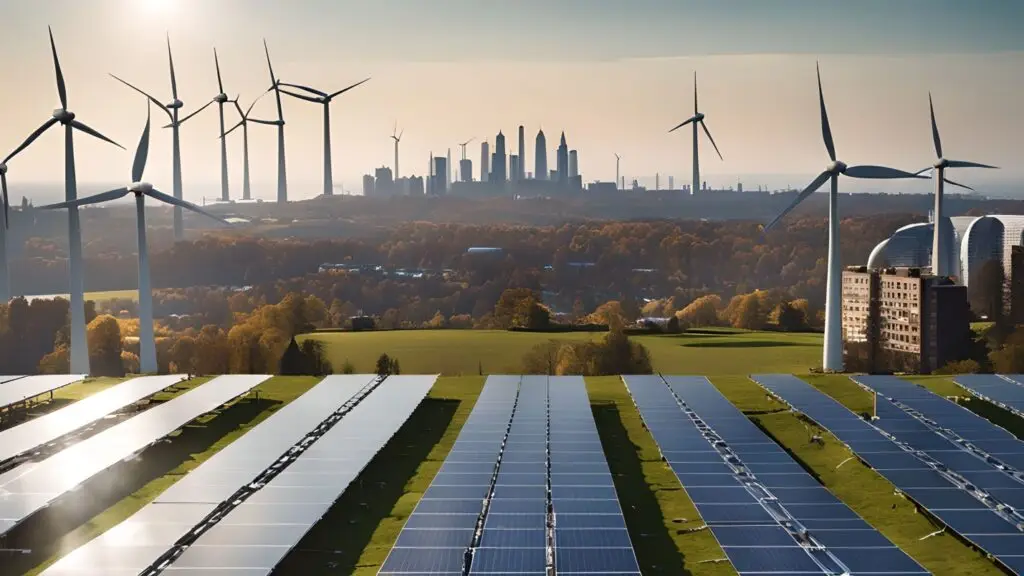
Infrastructure changes are likely coming to help, however it remains to be seen how effective they’ll be. Transitioning data centers to renewable energy sources like solar and wind reduces fossil fuel reliance at the source. Alternative cooling methods, including underwater and underground facilities, cut cooling energy demands. And improving Power Usage Effectiveness, the ratio of total facility power to IT equipment power, continues to yield gains. Google reports achieving PUE of 1.08 for some U.S. facilities, approaching the theoretical minimum.
A broader debate
As AI models become increasingly capable, critical questions emerge about whether the intelligence gains justify the environmental cost. The conversation has shifted from consumer-oriented concerns like battery life to systemic environmental sustainability and carbon footprint reduction. Each new model breakthrough now carries an implicit environmental price tag.
Corporate accountability is becoming harder to avoid. AI-driven firms face growing expectations to demonstrate energy consciousness in their operations. The financial incentives often align, since lower energy consumption directly reduces operating expenses, but active effort is required to realize those savings. Transparency in carbon reporting and energy auditing is becoming increasingly important for stakeholder trust, regulatory compliance, and public perception.
Perhaps most challenging is the need for industry-wide standards that move beyond the assumption that bigger models and larger datasets automatically mean better performance. Building benchmarks, collecting standardized data, and rethinking efficiency metrics across the industry remains an ongoing challenge. The current mindset rewards scale above all else, even when marginal capability gains come at disproportionate environmental cost.
Conclusions
Reducing AI energy consumption by even 10-20% through available techniques could meaningfully lower global data center emissions without requiring major capital investment. Many of the most effective interventions, from power capping to dynamic workload scheduling, are deployable today with existing infrastructure.
Yet even as individual model training becomes more efficient, cumulative energy demand continues to rise. The proliferation of AI applications, the scaling of inference infrastructure, and the frequency of model updates all contribute to a growing aggregate footprint. Efficiency gains are being outpaced by deployment growth.
Of course, there is another factor at play here — the amount of energy that AI could help save. While we haven’t yet seen concrete figures of how much energy AI-powered services are helping users and businesses save, the potential is certainly there.
There are some solutions out there — but again, it remains to be seen how willing big players are to actually adopt them. Between things like hardware optimization, software intelligence, new infrastructure, and adopted of renewable energy, hyperscalers could make a dent in the energy they consume — but it may take significant pressure, both political and social, for them to actually make moves.