

Table of Contents
If completed, the Terafab will supply chips for Tesla, xAI, and SpaceX
In sum – what we know:
- An unprecedented scale – The Terafab aims to eventually reach 100 million square feet and produce up to 1 million wafer starts per month, rivaling the output of industry giant TSMC.
- A focus on space – Approximately 80% of the facility’s compute output is earmarked for “D3” chips, which are radiation-hardened processors designed specifically for orbital AI satellites.
- Ambitious timelines – Construction has already begun in Travis County, with the goal of starting initial operations by summer 2026 to reduce dependency on suppliers like Samsung and TSMC.
Elon Musk seemingly wants a little more control over the chips used in his companies’ products. Tesla, SpaceX, and xAI have jointly announced “Terafab,” which will, according to the companies, be a massive semiconductor fab built in Giga Texas’s eastern Travis County campus. It stands as one of the most ambitious manufacturing bets any Musk company has ever placed — which, of course, also means we have no idea if and when it will actually get off the ground.
The projected price tag lands somewhere between $20 and $25 billion, though Tesla’s CFO made clear the full cost hasn’t been folded into the company’s 2026 capital expenditure plan, which already tops $20 billion by itself. How that gap gets bridged is anyone’s guess. Musk described the project as “the most epic chip building exercise in history by far” and positioned it as a step toward “starting a galactic civilization.”
Just how big is the Terafab?
On paper, the scope is pretty huge. Terafab is designed to bring every stage of semiconductor production under a single roof, including chip design, lithography, fabrication, memory production, advanced packaging, and testing. According to Musk, no other facility in the world currently offers that kind of fully integrated capability. The theoretical upside is a tight iteration loop for chip design that removes the need to shuttle wafers between sites spread across multiple countries.
Phase one clocks in at around 2 million square feet, roughly one-fifth of the main Giga Texas factory. That’s already massive, but apparently it’s just the starting point. Long-term plans envision the Terafab growing beyond 100 million square feet — a figure that, if it actually materializes, would make it one of the largest manufacturing facilities ever built.
Production targets are equally eye-popping. The initial goal is 100,000 wafer starts per month, eventually scaling to 1 million wafer starts per month. For context, that full-capacity number would represent about 70% of TSMC’s entire current global output — from one site. The overarching chip production target is 100 to 200 billion custom AI and memory chips annually.
Space computing
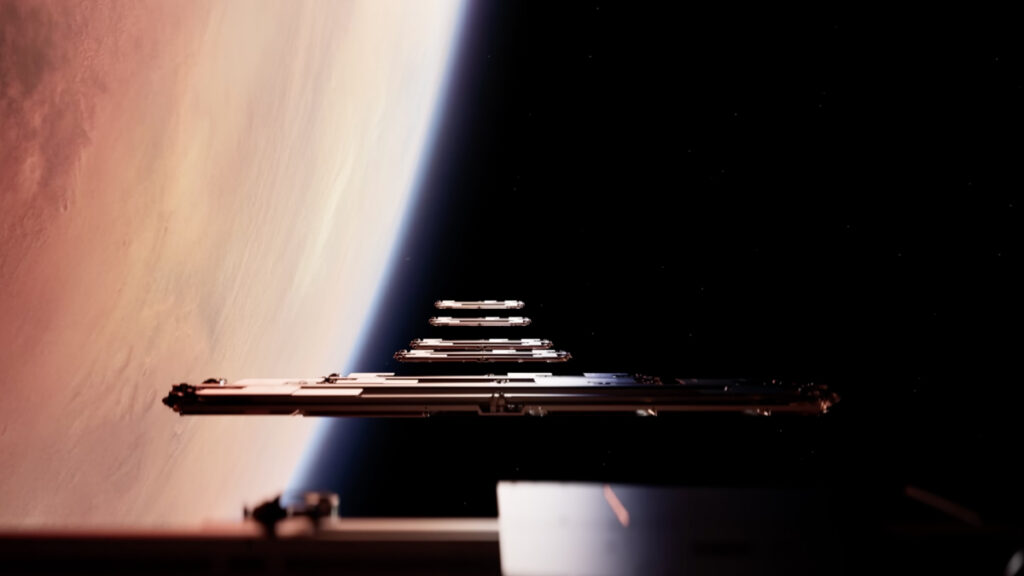
Not everything Terafab produces is meant to stay on Earth. Chip output will split into two main buckets — inference chips optimized for edge computing in Tesla vehicles and Optimus humanoid robots, and D3 custom chips engineered specifically for orbital AI satellites.
Musk stated that 80% of Terafab’s compute output will go toward space-based orbital AI satellites, with just 20% earmarked for ground applications. The D3 chips are purpose-built for the orbital environment — designed to run hotter than conventional chips in order to minimize radiator mass, and hardened against the radiation and thermal extremes of space.
The underlying logic for orbital AI datacenters comes down to physics. Musk claimed orbital AI compute could undercut terrestrial alternatives on cost within two to three years. That’s a bold projection hinging on launch costs, satellite reliability, chip yields, and a dozen other variables that are nowhere close to proven.
Why build a fab?
Musk acknowledged gratitude to existing suppliers, which include Samsung, TSMC, Micron, but was blunt about the disconnect between his companies’ hunger for chips and the industry’s willingness to expand capacity. “There’s a maximum rate at which they’re comfortable expanding,” he said, adding that the expansion rate is “much less than we would like.” The conclusion was simple: “We need the chips, so we’re going to build the Terafab.”
This isn’t purely abstract frustration, either. Tesla had already pushed its AI6 chip back roughly six months because Samsung’s 2nm production slipped — a very concrete example of the supply chain dependency Musk wants to eliminate. He did stress that all three companies will keep buying chips from their current suppliers even as Terafab ramps, framing it as a supplement to existing supply rather than a wholesale replacement.
Construction has already started. A 2-million-square-foot Advanced Technology Fab is going up at Giga Texas, with initial operations expected by summer 2026. Small-batch AI5 production is penciled in for later that year, though it’s worth flagging that Tesla had already delayed AI5 to mid-2027 before this announcement, so the timeline is fluid at best.
Reality distortion
Tesla and SpaceX have never fabricated a single chip. Designing chips and manufacturing them are fundamentally different disciplines, and the semiconductor industry is infamous for punishing newcomers with brutal learning curves, abysmal early yields, and timeline overruns that make even Musk’s typical delays look modest by comparison.
The cost math raises immediate questions. Industry benchmarks put a single 2nm fab capable of 50,000 wafer starts per month at around $28 billion, with roughly 38 months of construction time in the United States. Musk is projecting 100,000 wafer starts per month from an initial facility costing $20–25 billion — numbers that imply either a radically different approach to fab construction or a significant undercount of what this will actually cost. For perspective, TSMC has spent $165 billion over multiple years building six fabs in Arizona, and those facilities won’t reach 2nm production until 2029. despite being constructed by one of the most experienced chipmakers on the planet.
Musk’s relationship with timelines also deserves scrutiny. Overpromising and underdelivering on schedule has been a consistent pattern — Full Self-Driving, the Cybertruck, the Roadster, the Semi. The products usually show up eventually, just rarely when promised. A semiconductor fab, with its extreme precision requirements and multi-year ramp periods, seems like a particularly unforgiving arena for that habit. Even TSMC, armed with decades of fabrication expertise and every institutional advantage imaginable, has faced multi-year delays on its U.S. construction projects.
None of this means Terafab is impossible. But the chasm between announcement and execution here is enormous. This is either the opening chapter of a genuinely transformative manufacturing venture or one of the most expensive reality distortion fields ever projected. Probably some measure of both.
