

Table of Contents
Busways are designed to efficiently transmit large amounts of electrical power in a compact, modular, and scalable format—qualities that matter more as data centers grow in size and power density, especially with AI workloads.
In sum – what to know:
Power distribution – Busways deliver electricity through prefabricated busbars, replacing or complementing traditional cable-based systems in data centers.
Operational flexibility – Tap-off units allow operators to add or move racks without major rewiring or downtime.
Scalable design – Modular layouts support high-density environments, including AI-focused data centers with rapidly growing power demand.
Busways (also called bus ducts or busbar trunking systems) are a type of electrical power distribution infrastructure increasingly used in data centers as an alternative or complement to traditional cable-based power delivery. They are designed to efficiently transmit large amounts of electrical power in a compact, modular, and scalable format—qualities that matter more as data centers grow in size and power density, especially with AI workloads.
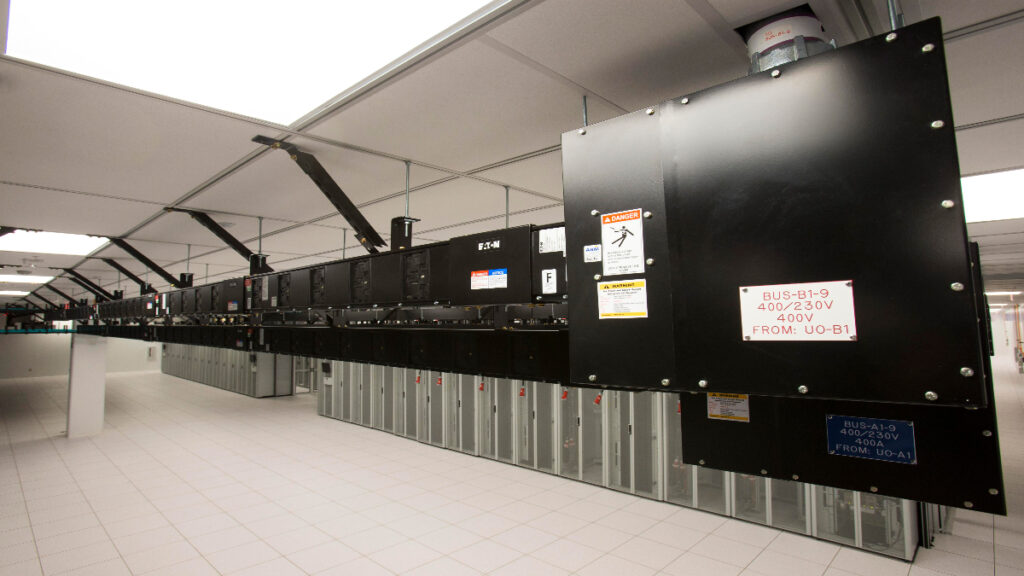
At a basic level, a busway is a prefabricated metal enclosure that contains solid copper or aluminum conductors (busbars) inside. These conductors run the length of the system and carry electrical current from a main power source—typically a UPS (uninterruptible power supply) or switchgear—to various load points such as server racks. Instead of running individual thick cables to each rack or power distribution unit (PDU), a busway creates a continuous “power highway” overhead or underfloor, from which power can be tapped at multiple points.
One of the key advantages of busways is flexibility. In a traditional cabling system, adding or relocating racks often requires rerouting or installing new cables, which can be time-consuming and disruptive. With a busway, operators can install tap-off units along the length of the system. These tap-off boxes connect to the live busbars and allow power to be drawn at specific points without shutting down the entire system. This makes it easier to reconfigure layouts, scale capacity, or support rapid deployments—common requirements in hyperscale and colocation environments.
There are several common implementations of busway systems in data centers. Overhead busways are installed above server racks, often suspended from the ceiling structure. These are widely used in modern hyperscale facilities because they free up valuable floor space and simplify airflow management. Underfloor busways are installed beneath raised floors and are sometimes used in legacy environments, although they are less common in new AI-optimized builds due to airflow and density constraints. Some facilities also use wall-mounted or vertically routed busway segments in constrained spaces.
Busways are typically designed in modular sections, which are joined together on-site. This modularity allows for relatively fast installation compared to pulling large cable bundles across long distances. They also come in different current ratings, often ranging from a few hundred amps to several thousand amps, depending on the power needs of the facility.
From an operational perspective, busways can improve reliability and efficiency. They reduce the number of cable terminations, which are common points of failure in electrical systems. They also help reduce voltage drop over long distances and can be easier to monitor when integrated with modern power management systems. In high-density AI data centers, where racks can consume tens of kilowatts each, the ability to distribute power cleanly and flexibly becomes critical.
However, busways also require careful planning. They must be precisely engineered to match load distribution, redundancy requirements, and safety standards. Tap-off points must be managed to avoid overloads, and maintenance procedures must account for the fact that the system remains energized along its entire length.
Overall, busways are becoming a key part of modern data center power architecture. As demand for scalable, high-density computing continues to rise, especially driven by AI infrastructure, operators are increasingly adopting busway systems to support faster deployment cycles, higher flexibility, and more efficient use of space compared to traditional cabling approaches.
