

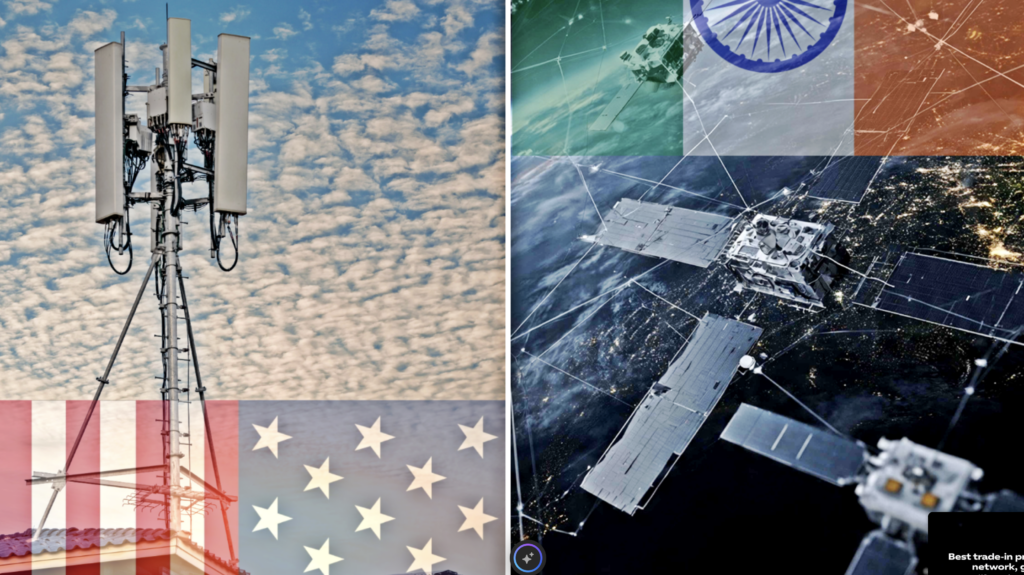
What to know today, beyond all of the good commentary coming out of Industrial Wireless Forum this week – including, today, discussion of the network impacts from physical AI in motion. But what else? The satellite land-grab is getting more interesting. Reliance in India is looking to build a 1,600-satellite LEO constellation, reports Bloomberg, with a late-2027 test mission and a 2035 completion target. Which sounds like a serious statement of intent from one of India’s biggest business empires – but also a long way from a credible Starlink rival, and plenty of time for Starlink to make the gap bigger. As we have seen with the launch travails at Amazon Leo, the vertical integration that SpaceX has achieved translates into a massive and widening advantage in hyper-scale space comms.
Meanwhile, as first flagged by Ookla analyst Mike Dano on LinkedIn, and subsequently picked up everywhere: T-Mobile is adding to its own low-band arsenal, seeking FCC approval to acquire 58 additional 600MHz licences from Bluewater Wireless, covering 435 counties across 27 states. The timing is interesting, with Starlink also hunting for low-band spectrum. This is a coverage and capacity play, rather than a speed story: 600MHz travels further and penetrates buildings better than mid-band, but is considerably slower than T-Mobile’s 2.5GHz holdings. The spectrum land-grab is becoming another front in the competition between terrestrial and satellite networks. Spectrum is like the terrestrial equivalent of a rocket ship.
Also interesting: today, Ericsson and Altair Semiconductor have announced they have completed the first eRedCap 5G network connection, using Ericsson RAN software and Altair’s ALT1550 modem. RedCap, in all its forms, was all the rage 12 months ago, but has gone weirdly quiet. This looks like a useful step towards cheaper, lower-power 5G devices, from industrial sensors and trackers to AI wearables. Commercial deployments are targeted for 2027. The interesting bit is the widening of the 5G device market: not everything needs smartphone-class connectivity, of course, and eRedCap might just give operators a more credible route into the long tail of IoT.

James Blackman
Executive Editor
RCR Wireless News
RCR Top Stories
5G for physical AI: Physical AI is pushing private 5G to also deliver predictable latency, stronger uplinks, and reliable mobility as autonomous machines proliferate. XCOM RAN outlines how networks must adapt.
About Huang’s exit: Nvidia faces a leadership vacuum following Jensen Huang’s departure, with $530 billion in guarantees, AI infrastructure financing, chip export controls and rising rivals all potentially exposed to a more cautious succession.
5G-ports pressure: Spectrum access for private 5G at ports remains an issue as differing national rules complicate network planning, coordination, and the delivery of reliable connectivity for increasingly automated operations.
Co-packaged optics: co-packaged optics and the OCI-MSA are unlocking multi-rack AI scaling and speeding time-to-revenue for data centers as copper cables hit physical limits at 200G to 400G,
P5G is the answer: AI puts private 5G back in the spotlight, as enterprises connect more devices and demand more from industrial systems. The size of the connectivity gap depends on how far they have travelled with private 5G.

AI-Powered Telecom Infrastructure
Supermicro, in collaboration with NVIDIA, delivers AI-powered infrastructure tailored for telcos, enhancing operational efficiency, network management, and customer experiences. Explore now
Beyond the Headlines
UK AI-RAN trial: VodafoneThree will test Nokia and Nvidia’s AI-RAN platform, initially in the lab before the field, to assess RAN gains and whether GPU-powered infrastructure can support network slicing and third-party AI workloads.
Wi-Fi landscape: Following Cambium’s collapse, US multi-family Wi-Fi providers are reassessing their vendors as RUCKUS loses ground, TP-Link faces regulatory scrutiny and Cambium changes hands. Maravedis maps the contenders.
AI-RAN for I4.0? BASF says AI is accelerating private 5G, not justifying it – while its existing edge infrastructure makes AI-RAN a poor fit. Its experience challenges assumptions about what industrial AI actually needs at large sites.
All eyes on ISAC: Nokia is testing ISAC for US drone detection, while Elisa and Telefónica are putting public and private 5G to work in European defence projects – and Ericsson has a smart view of developments, besides.
Satellites down: ULA’s first launch failure in 20 years has destroyed 40 Amazon Leo satellites, dealing another blow to Amazon’s delayed constellation and exposing its dependence on struggling third-party rockets to challenge SpaceX.
What We're Reading
Starlink rival: Reliance is pursuing deals to build a 1,600-satellite constellation, targeting completion by 2035. The Indian-controlled network would challenge Starlink, with a test mission planned for late 2027
5G eRedCap: The first eRedCap 5G connection has been completed using Ericsson RAN software and Altair’s ALT1550 modem. The tech targets cheaper, lower-power IoT and AI devices, with deployments in 2027.
P5G on DAS: Moso Networks, SOLiD, and CTS are combining CBRS private wireless with existing DAS systems to allow enterprises to add dedicated 5G connectivity without duplicating in-building distribution infrastructure.
Physical AI-IoT: Soracom has a physical AI suite for cellular, Wi-Fi, wired, and satellite IoT comms with security and management for robots etc. The package supports secure model updates, maintenance, and automation.
Seaside small cells: Freshwave will deploy 10 outdoor small cells for O2 across Tenby, boosting 4G/5G capacity in busy areas ahead of summer 2027, under an open-access infrastructure agreement with Pembrokeshire County Council.
Latest RCRtv Interviews
Events
AI Infrastructure Forum, December 8th, Virtual
Join RCRTech’s AI Infrastructure Forum to explore how telcos, hyperscalers and data centres can compete or partner as AI shifts to inference, and who captures the value when every token counts. Register now
Wi-Fi Forum, January 19th, 2027, Virtual
Join the Wi-Fi Forum to hear from esteemed industry leaders, operators, enterprises, technology innovators, standards bodies, and policymakers on how Wi-Fi is evolving into intelligent infrastructure for the next generation of connectivity. Register now
PTC’27, 17-20 January, 2027, Honolulu, Hawaiʻi
PTC’27 is the premier event for digital infrastructure, telecoms and ICT. Executives, investors and researchers meet to share knowledge, build relationships and drive new business. Register now
Industry Resources
RCRTech Trend
WiFi Driving Telco Growth
RCRTech Trend
Rise of Non-Terrestrial Networks (NTN)