
 Susana Schwartz
Fed Chair mulls 'contingencies' without tying AI to inflation
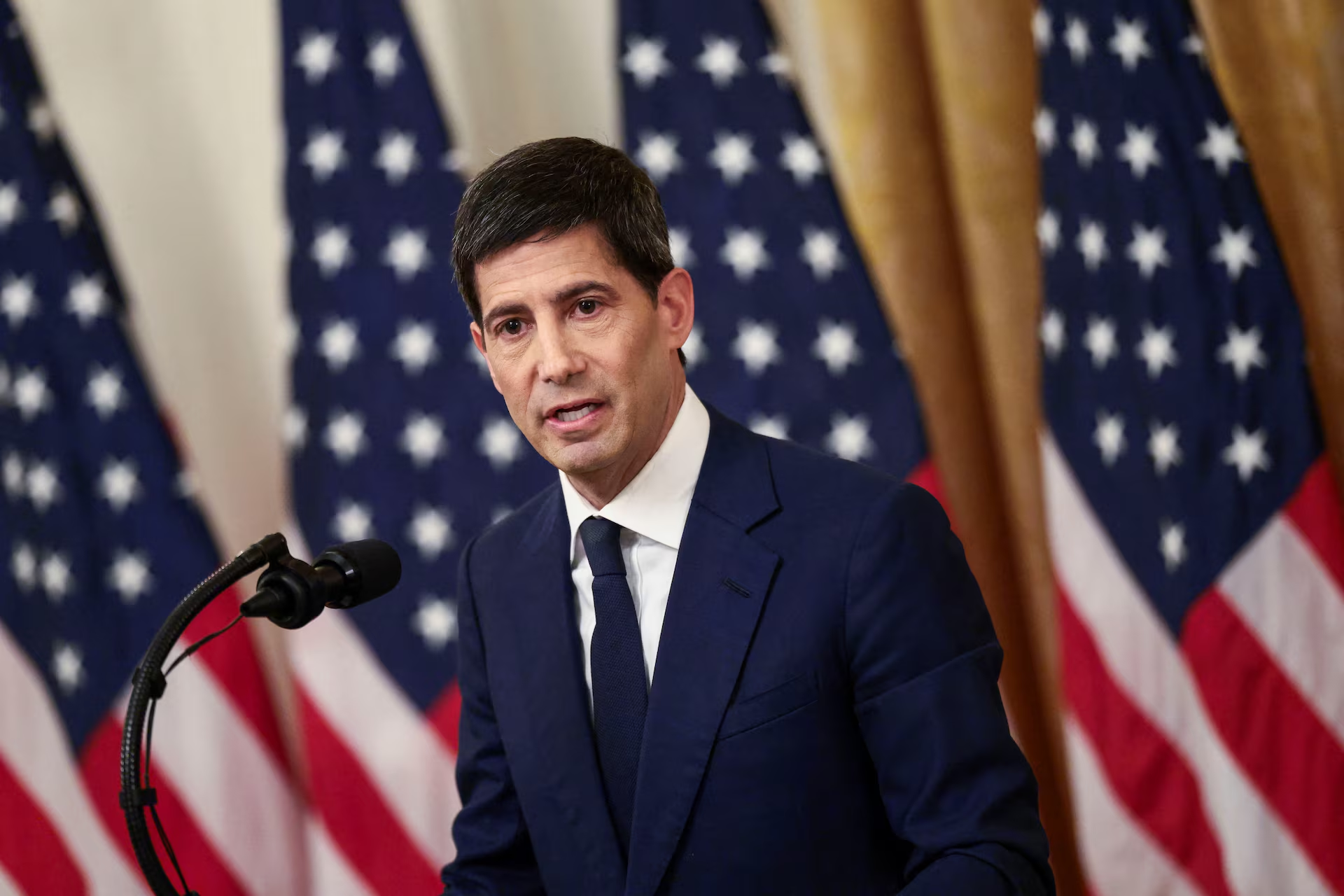
Federal Reserve Chairman Kevin Warsh addressed AI and the economy today during the Federal Reserve Bank’s “Productivity and Jobs Task Force Conference” in San Francisco.
Warsh kicked off the event by saying, “We’ve got a job to do in monetary policy, so it’s worth considering the range of economic outcomes we could see the next several years, depending on how ‘superintelligence’ progresses.” He then spoke at a high level about the “various contingencies” he and his staff are evaluating by applying stylized, model-based frameworks to generate scenarios. On one end, he says, “SI will lead to economic gains that are shared broadly across labor and owners of capital, with GDP growing persistently above its long-term average, and the U.S. stays close to full-term employment.” Those gains, he felt, would come if AI drove total factor creativity and democratization of knowledge.
On the other side of the spectrum, he talked of “substantial market disruption and job displacement,” with widespread automation combined with labor market frictions pushing the jobless rate “above levels consistent with full employment.”
A third scenario, he posited, would be one where “SI would disappoint” despite significant capital investment, “with stock market gains and expected returns turning down,” and with falliing equity valuations that would lead to “an economic slowdown and a more notable rise in unemployment.” In time, he assured, “the economy would recover, but without the productivity gains.”
It was notable that he avoided correlating AI and data center buildouts to inflation – something other fed officals, like Chicago Fed President Austan Goolsbee and Fed Governor Lisa Cook’s, have done when talking about the rising costs of electricity, copper, computer chips, and consumer electronics prices.
Overall, the tone of his speech and subsequent panel discussion seemed broadly optimistic, though with a little more caution present than in his past talks.
Alongside labor market disruptions, Warsh framed critical infrastructure as a high-level national security and economic stability risk (rather than as a purely technical one) that could invite “bad actors” and foreign adversaries, noting “SI empowers all, including bad actors, so we are thinking especially of critical infrastructures and their potential vulnerabilities.”

Susana Schwartz
Technology Editor
RCRTech
AI Infrastructure Top Stories
DT’s $276M AI factory expansion: Phase 1of Deutsche Telekom’s Munich Tucherpark sold out in just 7 months, so there will be an additional $276 million to double the facility’s computing power to 20 MWs, with roughly 20,000 Nvidia GPUs.
Monetize 6G with ISAC?: Though physical AI and AI-native processing get attention on 6G roadmaps, integrated sensing and communication (ISAC) may be an “early revenue bet,” with radio networks detecting objects and carrying data.
AI Today: What You Need to Know
New export controls on DCs: The Trump administration has enacted new rules requiring data centers serving China, Russia, Iran and Cuba to identify their end users, with promises of stricter case-by-case licensing for AI chip sales.
Blackstone REIT $5B AWS deal: Blackstone’s DC REIT, Blackstone Digital Infrastructure Trust, is acquiring a 75% stake in a data center portfolio that was fully owned by AWS in a deal valued at roughly $5 billion for 13 powered shells.
CoreScientific grows colo biz: Core Scientific announced on its earnings call it will pivot from Bitcoin mining to high-density colocation for AI workloads by next year, with colocation revenue of $215 million – up nearly 60% from Q2.
AG Bonta sues OpenAI: California Attorney General Rob Bonta filed a lawsuit against OpenAI this morning, asserting that the company “misled and endangered the public” by developing and testing AI models without sufficient safeguards.
WSJ looks at China’s ‘backdoor’: A closer look at how Nvidia’s Jensen Huang might’ve built the “backdoor route” to supply restricted AI chips and remote computing power to Chinese companies.
Latest RCRtv Interviews
RCR Events
AI Infrastructure Forum, December 8th, Virtual
Join RCRTech’s AI Infrastructure Forum to explore how telcos, hyperscalers and data centres can compete or partner as AI shifts to inference, and who captures the value when every token counts. Register now
PTC’27, 17-20 January, 2027, Honolulu, Hawaiʻi
PTC’27 is the premier event for digital infrastructure, telecoms and ICT. Executives, investors and researchers meet to share knowledge, build relationships and drive new business. Register now
Industry Resources
RCRTech Trend
Rise of Non-Terrestrial Networks (NTN)