

Table of Contents
The RTX Spark “superchip” is powerful enough to run 120B-parameter models and persistent agents without the cloud
In sum – what we know:
- From cloud to endpoint – RTX Spark moves serious inference onto the device, running 120B-parameter models with million-token contexts locally instead of calling out to the cloud.
- Agents as a first-class feature – Nvidia and Microsoft are building Windows around persistent local agents that observe system state and act in the background, with controls exposed in the taskbar.
- CUDA on the client – Native CUDA on Arm plus TensorRT, cuDNN, and Triton create a desk-to-laptop continuum for developers—convenient, but deepening Nvidia’s lock-in across the stack.
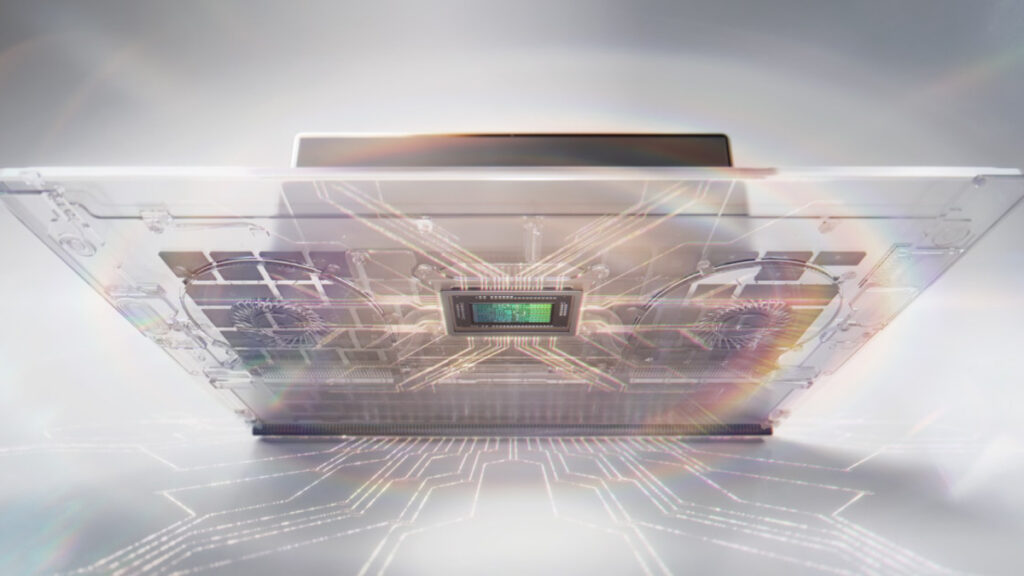
Nvidia wants to bring its chip and AI expertise to more consumer products. The company used Computex 2026 to put a new kind of chip on the map. The RTX Spark is an Arm-based “AI superchip” system-on-a-chip built for Windows on Arm PCs, and it packs a 20-core Grace CPU with a Blackwell-generation RTX GPU into a single package. That combination is unusual for a consumer device. Nvidia has spent years selling discrete GPUs into laptops and data centers, but this is the company stepping in as the silicon platform itself, not just the graphics supplier bolted onto someone else’s CPU.
The pitch is that RTX Spark becomes the foundation for a new tier of “personal AI computers” — machines designed to run persistent, local AI agents rather than just respond to the occasional prompt. Nvidia and Microsoft have gone so far as to call RTX Spark systems the “first PCs designed for AI agents,” which is the kind of framing that invites skepticism. The idea is to take the data-center-style Nvidia AI stack and shrink much of it down into thin laptops and compact desktops.
Basically, Nvidia is positioning RTX Spark as the Windows answer to Apple’s M-series. It’s an Arm SoC with an integrated high-end GPU, unified memory, and strong AI accelerators, tuned for RTX graphics and CUDA rather than Metal. Microsoft is treating these systems as part of its Copilot+ and “agentic Windows” vision, and has already branded a flagship Surface Laptop Ultra and a new Surface RTX Spark Dev Box around the chip.
Technical architecture
The CPU side is a 20-core Grace design built from Arm cores, a client-oriented derivative of Nvidia’s server-class Grace work. The GPU is the more interesting half. It’s a Blackwell-generation RTX part with roughly 6,144 CUDA cores and fifth-generation Tensor Cores, which puts its graphics performance in the RTX 5070 Laptop GPU class. That’s a respectable target for an integrated solution, though the headline number Nvidia wants you to notice is the AI throughput. RTX Spark can reach up to 1 petaFLOP of AI compute, largely via FP4 and other low-precision tensor operations. For inference and lightweight training, that’s well above what current laptop NPUs and integrated GPUs manage.
Memory is where the design genuinely diverges from a typical laptop. RTX Spark uses up to 128GB of LPDDR5X unified memory shared across the CPU, GPU, and NPU. Conceptually this is similar to Apple’s unified memory, but the capacity is aimed at very large local models and heavy 3D work rather than general productivity. Tying it together is NVIDIA’s NVLink C2C chip-to-chip interconnect between the CPU and GPU blocks, designed to keep latency low and bandwidth high inside the package.
Power is configurable, which matters for what these machines can sustain. Laptops will run on typical mobile budgets, while Microsoft’s Surface RTX Spark Dev Box mini-PC is built for sustained workloads at around 100W TDP. That higher envelope is the difference between a chip that can burst and a chip that can run agents and training jobs around the clock.
Early products and form factors
The flagship laptop is Microsoft’s Surface Laptop Ultra, which pairs the superchip with up to 128GB of unified memory and full CUDA support. Microsoft markets it as capable of running 120-billion-parameter models locally, which is the kind of claim that sets the tone for the whole category. Alongside it sits the Surface RTX Spark Dev Box, a Surface-branded mini-PC aimed at developers and built to run at a sustained 100W for long training jobs, agentic pipelines, and local model fine-tuning.
Asus is coming in from the creator angle. Its RTX Spark notebooks are configured to render 90GB+ 3D scenes, edit 12K 4:2:2 video, run 120B-parameter LLMs with context windows up to a million tokens, and play AAA games at 1440p. Other OEMs are expected to follow in fall 2026, including Lenovo, Acer, Dell, HP, MSI, and GIGABYTE, with some thin-and-light designs reportedly down to 14 mm.
It’s worth separating RTX Spark from the DGX Spark, because the names invite confusion. DGX Spark is a distinct, Linux-based “AI supercomputer on your desk” for developers, also offering up to 1 petaFLOP and 128GB of memory, but aimed at more serious AI development and validation. RTX Spark adapts much of that capability into a Windows-on-Arm consumer and prosumer form factor, with the emphasis shifted toward portability, UX, and OS-integrated agents.
AI capabilities and dev workflows
The standout capability is local large-model inference. Nvidia, Microsoft, and the OEMs consistently claim RTX Spark PCs can run open-source LLMs up to roughly 120 billion parameters locally, which is far beyond what today’s “AI PC” NPUs typically handle on-device. The 128GB of unified memory is what makes that plausible, and it also supports very large context windows. Nvidia and Asus cite up to a million tokens for certain 120B models, enough to process complex multi-step tasks and large document sets entirely on the machine in front of you.
Then there’s the agent angle, which is the part Nvidia and Microsoft care about most. Windows on RTX Spark is built to run persistent local agents that observe system state, manage workflows, generate assets, and handle background tasks with low latency while keeping sensitive data on the device. Nvidia describes these agents as “working alongside you” rather than waiting on single prompts. Microsoft plans to expose agent controls directly in the Windows taskbar, making them a first-class OS feature tied into Copilot+ rather than a standalone app. Whether users actually want a background agent quietly orchestrating their desktop is its own debate, but the hardware is being shaped around the assumption that they will.
The platform isn’t limited to inference. RTX Spark and the Surface Dev Box are marketed for long-running training jobs and local fine-tuning too. This is nowhere near H100-class training, to be clear. But a petaflop in a 100W box with 128GB of unified memory is enough for LoRA-style fine-tuning, embedding model training, building RAG indexes, and general experimentation by individual developers or small teams. For the people doing that work, the appeal is that RTX Spark runs CUDA natively on Arm and supports the broader Nvidia AI stack, including TensorRT, cuDNN, and Triton. That means much of the tooling developers already use for data-center work carries over to the client machine.
Software ecosystem
RTX Spark is, first and foremost, a Windows on Arm platform, and Microsoft is using it to accelerate the high-end push away from x86. The two companies are co-designing the OS-level pieces — Copilot+, agent orchestration, and the security controls that govern model access and data — with references to features like Nvidia OpenShell for secure agent execution. Hardware and OS-level protocols to keep agents constrained are going to matter more as those agents gain the ability to act on the system, not just talk.
On the application side, Adobe is rebuilding Photoshop and Premiere to run natively and take advantage of both the GPU and NPU for generative fills, video effects, and the like. Nvidia and Asus also name native support for Blackmagic DaVinci Resolve 21, Blender, and the wider Adobe Creative Cloud suite. That’s the cohort of demanding creative apps the platform is leaning on to prove itself.
The catch is the same one Windows on Arm has always faced. Legacy x86 Windows applications depend on emulation or recompilation, and performance for heavily CPU-bound, unoptimized legacy software is an open question — though a lot of these issues have been ironed out over the past few years with the Snapdragon X series of chips from Qualcomm. GPU-accelerated and native Arm apps should fare much better. Microsoft and NVIDIA are betting that the workloads that matter for an AI PC — agents, creative tools, dev frameworks, and games that lean on GPU acceleration — will be native or well-optimized, which would mitigate the compatibility burden over time. That’s a reasonable bet, but it’s still a bet.
Edge-to-cloud implications
The most consequential shift here is moving inference from the cloud to the endpoint. With 120B-parameter models and million-token contexts running locally, a lot of tasks that currently need cloud inference — complex coding assistance, full document summarization, some forms of RAG — can run on the device. That potentially reduces cloud inference spend for high-frequency, user-specific workloads, and it sidesteps latency and connectivity issues. Heavy training and the very largest models will stay cloud-centric, of course, but the day-to-day reasoning can move closer to the user.
What this introduces is a “personal AI node” at the edge. Traditional AI infrastructure gets described in terms of data-center GPUs, networking, and storage. RTX Spark inserts a meaningful inference and light-training resource on each user’s desk, which encourages federated and distributed patterns where models personalize on-device, train small adapters locally, and periodically sync back to central services. The 128GB of unified memory is what makes that workable on a client. Developers can run massive multi-modal vector databases and local RAG pipelines entirely on-device, keeping extensive context in memory rather than repeatedly calling out to the cloud. It blurs the line between “client” and “workstation.”
There’s a data-governance dividend too. Local agents let enterprises keep sensitive data and conversations on the machine, relying less on shipping raw content to cloud LLM endpoints, which can simplify compliance for certain workloads. And for developers specifically, DGX Spark and RTX Spark together create a desk-to-laptop continuum — heavy validation on DGX Spark or larger clusters, daily development and agent design on RTX Spark hardware. That can shorten iteration cycles, since engineers can test large models and long-context flows locally before committing anything to a data center.
Unknowns
For all of that, independent validation is thin. Early dev benchmarks suggest strong performance in some workloads relative to Apple’s M-series, but official, broad benchmarks and sustained-load testing aren’t available yet. Until they are, the headline numbers are Nvidia’s numbers.
Thermals are the obvious pressure point. Nvidia calls RTX Spark the most efficient PC chip it has made, but running 120B-parameter models, 90GB 3D scenes, and 12K video is inherently power-hungry. How thin laptop chassis manage heat under sustained AI load — without throttling or loud fans — is unproven. Battery life is the flip side of the same problem. It’s not at all clear how much of the headline capability is realistic on battery versus plugged in.
Compatibility remains the long-standing Arm risk. The Windows-on-Arm ecosystem is improving but still isn’t as mature as x86, and emulation performance for diverse, CPU-bound, or unoptimized legacy enterprise apps is genuinely uncertain. Enterprises may hold off on standardizing around Arm laptops until management tooling and compatibility are proven at scale. Pricing is the other gatekeeper. Configurations with 128GB of unified memory will almost certainly command premium prices and stay confined to high-end SKUs at first, which would make RTX Spark’s impact on mainstream edge AI more gradual than the launch hype suggests.
Finally, there’s the question of vendor concentration. By extending its dominance from the data center to the client, Nvidia becomes an even more central single vendor across the AI stack, which raises the familiar concerns about pricing leverage and proprietary lock-in. RTX Spark encourages CUDA-first development from local prototype through cloud deployment, and that’s a double-edged sword. It’s convenient for developers already living in Nvidia’s world, and it’s a steeper hill for AMD, Intel, and emerging accelerators trying to compete on open standards.
