

Table of Contents
Oracle will resell TPUs from 2027, and Anthropic drives the demand
In sum – what to know:
- A wider distribution model – Google has gone from selling TPUs to a select group of customers to letting Oracle, the first rival hyperscaler, resell them from 2027.
- Anthropic-heavy demand – Anthropic’s IPO filing commits it to at least $114.5 billion of spending with Google through July 2033, and it underpins the $63 billion financing package.
- Google-backed risk – Alphabet disclosed a potential $6.6 billion buyback obligation on TPU systems already sold, and energy guarantees that now run to January 2049.
Since 2015, Google has kept its Tensor Processing Units, or TPUs, inside its own infrastructure. It started chipping away at that in April, when it said it would sell TPUs to a select group of customers for their own data centers. This week widened the aperture further, with the first rival hyperscaler agreeing to resell the chips. The company is moving toward distributing its custom AI silicon through third parties rather than only through Google Cloud, an attempt to turn a long-running internal advantage into a hardware business.
The shift came in quick succession. A $63 billion financing package for Broadcom-built AI accelerators destined for Anthropic arrived on Oct. 26, followed by an Oracle deal and a report that OpenAI plans to buy TPUs on Oct. 27. Alphabet’s earnings the next day named TPU system sales as a meaningful revenue contributor, with a larger ramp expected in 2027.
Google opens its TPUs to rival clouds
Oracle Cloud Infrastructure will become the first hyperscaler outside Google to offer TPUs in calendar 2027, with capacity ramping over several years. Oracle supplies the power, cooling and data center networking, while Google provides the chips, software and interconnects. Oracle will reportedly buy the chips directly, according to coverage citing The Information, and has said that when Google launches a new TPU generation it will offer that one on day one. Pricing, configurations, initial capacity and a firm launch date remain undisclosed. Oracle used the same event to put Nvidia’s Vera Rubin NVL72 systems into general availability and announce a multi-gigawatt expansion, placing TPUs alongside Nvidia, Cerebras and SambaNova rather than in place of them.
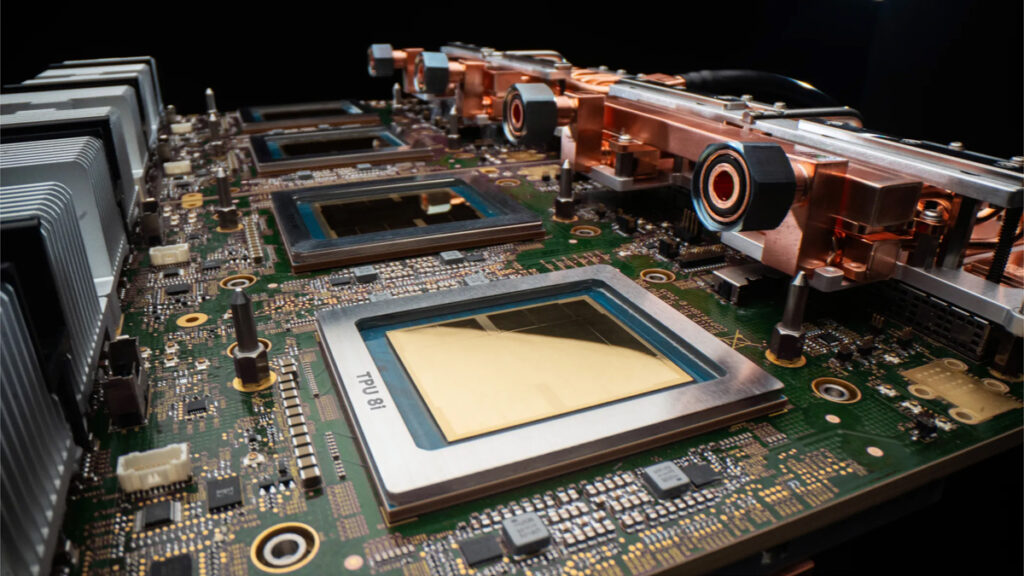
Oracle’s Acceleron networking stack will connect TPU capacity to the rest of its cloud, while Google’s own inter-chip interconnect and optical circuit switching carry traffic between the chips. The eighth-generation TPUs split into TPU 8t for training models and TPU 8i for inference, or running them. The 8t supports 9,600-chip superpods and 216GB of HBM3e, a fast form of memory stacked close to the processor, per chip. The 8i increases that to 288GB and adds 384MB of on-chip SRAM.
Google claims the 8t delivers up to 2.7 times the performance per dollar of its previous-generation Ironwood, while the 8i offers up to 80% better performance per dollar, particularly at low-latency targets for large mixture-of-experts models. Those are Google’s figures, and independent systems aren’t yet available to test them.
The distribution strategy still sets Google apart from Amazon’s Trainium, Microsoft’s Maia 200 and Meta’s MTIA, all of which remain internal for now. Amazon CEO Andy Jassy said on Oct. 29 that Trainium demand has customers pushing Amazon to sell it outside AWS, which he said it intends to do late in 2027. Google’s argument is straightforward. Wider distribution expands its potential market and monetizes more than a decade of silicon development, and the company says it already has over 100 significant TPU customers.
Anthropic and OpenAI drive TPU demand
Anthropic is doing much of the heavy lifting. The $63 billion financing uses a special-purpose vehicle, a separate financial entity created for the deal, to buy Broadcom-built AI accelerators and networking equipment and lease them to Anthropic. Deliveries begin in 2027, with Broadcom providing residual-value support that backs part of the equipment’s value.
Anthropic agreed in October 2025 to use up to one million TPUs. Its IPO filing now commits it to at least $114.5 billion of spending with Google between April 2026 and July 2033, payable even if it falls short of the committed volume. William Blair estimates the financing covers about half of Anthropic’s 2027 requirements, implying more arrangements ahead. Apple provides another useful reference, having publicly discussed pretraining foundation models on TPUs.
OpenAI could broaden the customer base further. The Information reported that it plans to buy TPUs directly rather than simply rent them. OpenAI has rented Google AI chips since June 2025 and unveiled its Jalapeño inference chip with Broadcom in June, with initial deployment targeted by the end of 2026.
Software remains a hurdle. OpenAI’s stack centers on PyTorch and Nvidia’s CUDA platform, while TPUs have favored Google’s JAX framework and XLA compiler, which translate models into instructions the chips can run — a gap Google narrowed on Oct. 20, when it and Meta open-sourced TorchTPU, a native PyTorch backend for TPUs. The earliest savings are therefore likelier in inference than frontier-model training.
Google is also supplying Anthropic, whose Claude models compete directly with Gemini, and in which Alphabet owns about 14%, having agreed in April 2026 to invest up to $40 billion. Nvidia, meanwhile, reported $96.2 billion in revenue for its most recently reported quarter, and its stock fell about 3.5% over the week — a decline attributed to a chip-wide selloff after Intel’s guidance rather than to the TPU news. Broader TPU adoption could pressure its pricing over time, but it hardly amounts to an immediate displacement.
Cloud growth and related-party backlog
Google Cloud’s numbers were formidable. Revenue reached $30.7 billion, up 103% year over year and its highest growth rate yet. Operating income rose 209% to $11.1 billion, while margins expanded from 23.7% to 36.2%. Backlog hit $561 billion, with just over 55% expected to be recognized within 24 months.
But a sizable piece came from inside Google’s orbit. Crux AI, its joint venture with Blackstone, generated more than one-third of the quarterly backlog increase through a $16.8 billion multiyear agreement. Alphabet holds a minority interest and has committed up to $10 billion in data center and power guarantees. That is a slice of the quarter’s growth, though: the $16.8 billion sits inside $561 billion of Cloud backlog, most of which has nothing to do with the venture. Even so, it makes the backlog look less like a clean measure of outside demand.
The cash mechanics are less flattering too. Free cash flow was negative $9.1 billion as TPU systems tied up inventory before generating revenue and a $5.2 billion European Commission fine was paid. Quarterly capital expenditure reached $51.4 billion, with full-year 2026 spending held at $195 billion to $205 billion and a significant increase flagged for 2027. Investors read the quarter as a spending story: shares fell about 13% on Oct. 29, Alphabet’s worst day as a public company, erasing roughly $500 billion in market value. Alphabet’s filing also disclosed that it could be required to buy back up to $6.6 billion of TPU systems already sold — a guarantee customers can trigger by returning systems at a pre-set discount, which Google does not expect them to use because they have no economic incentive to.
Google Cloud CEO Thomas Kurian said at a September investor conference that Alphabet’s payback period on AI servers is under two years, and that on its own silicon it is half what GPUs cost — a claim about Google’s own fleet, not about what outside buyers will get. TD Cowen’s model is less generous on margins, putting external TPU sales near 20% operating margin versus 35.6% for cloud overall in the second quarter. Analyst estimates for 2027 TPU revenue run from about $40 billion at BNP Paribas to $99 billion at Wells Fargo, with TD Cowen at $62.5 billion; those are models, not Google disclosures.
The unresolved issue is how much demand would remain without related-party financing and Google-backed guarantees, and whether those buyback clauses stay a footnote if the AI cycle cools.