

Table of Contents
Both are 2nm with the same 5GHz Oryon CPU
In sum – what we know:
- A two-tier split – Qualcomm ships the Snapdragon 8 Elite Gen 6 in standard and Extreme versions, both on a 2nm process with the same Oryon CPU.
- On-device model headroom – A new Element Accelerator and a precision range spanning INT4 through FP16 target the local AI workloads heading to phones.
- What the Extreme adds – Matrix cores and 50% more NPU shared memory are exclusive to the Extreme, aimed at larger on-device models and agentic features.
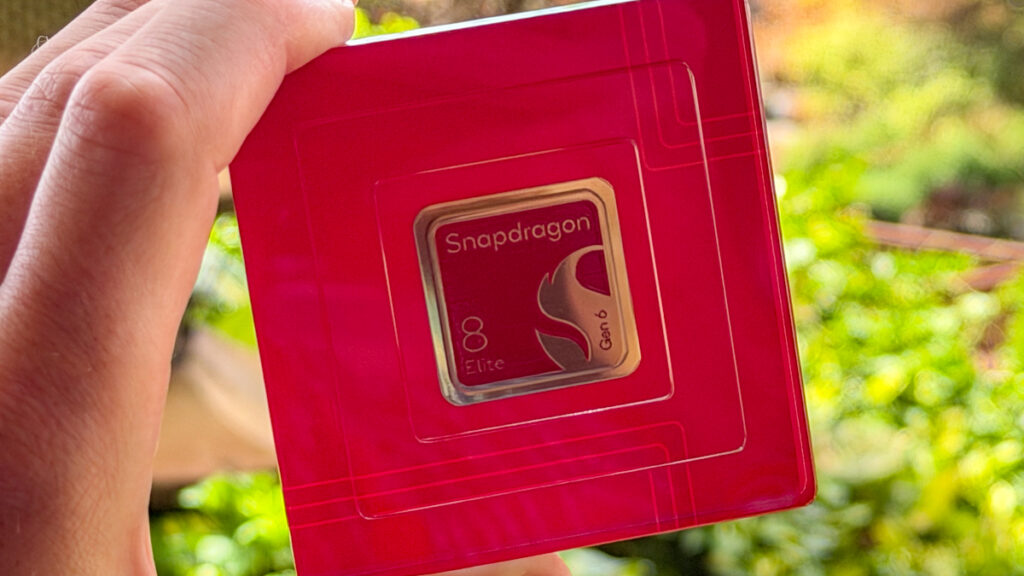
Qualcomm has split its flagship smartphone chip in two. The company has announced the Snapdragon 8 Elite Gen 6 and a higher-spec Snapdragon 8 Elite Extreme Gen 6, the first time it has launched two top-tier flagship chips simultaneously. As you would expect in 2026, the main talking points around the chips relate to on-device AI.
Qualcomm’s pitch is “agentic AI,” meaning an assistant that holds onto personal context, works across apps, and carries out multistep tasks on the phone itself. That’s a direct challenge to the assumption that serious AI belongs in the cloud, and the economics explain why chipmakers want to make it. Cloud inference is expensive at scale, and every round-trip to a server costs latency, exposes data, and racks up per-token fees. Run the model locally and you get faster responses, features that work offline, and less personal data leaving the phone.
Of course, Local AI is a different tier from cloud AI, and model size, memory, and thermals impose limits a data center simply doesn’t face. So Qualcomm, like its rivals, is really betting on hybrid — the phone handles the fast, private, context-rich work, and the cloud takes anything heavy, fresh, or compute-bound. The question is where the line between those should be.
Qualcomm brought me out to Hawaii for its annual Snapdragon Summit event to learn about the new chips and what they can actually do.
What the silicon actually changes for AI
Both of the new chips are built on a 2nm process and share the same Oryon CPU layout, with two Prime cores at up to 5GHz and six performance cores at up to 4GHz. Qualcomm calls it the world’s first mobile CPU to hit 5GHz.
The differences sit around the Hexagon NPU, the neural processing unit that handles local AI workloads. Qualcomm says the Extreme gets a 50% larger NPU shared-memory subsystem, which is arguably the most important change here. Language models are hungry for memory bandwidth, and they spend much of their time moving data rather than computing on it. Keeping more of a model’s working state on-chip, including activations and the KV cache (the running record of previous tokens a model consults as it generates each new one), means less shuttling back and forth to the phone’s DRAM. That saves both time and power.
Both chips add what Qualcomm calls a Hexagon Element Accelerator, a block aimed specifically at transformer math. And, it supports a wide ladder of numerical precision, from INT2 and INT4 through INT8, INT16, FP8, and FP16. Lower precision means smaller, faster, less power-hungry models at some cost to output quality, and offering the whole ladder lets developers pick that trade-off per task. On the Extreme’s NPU, Qualcomm claims up to 50% faster prefill for INT4 models. Prefill is the stage where a model digests your prompt and context before producing anything, so it largely determines how long you wait for the first word of a response. For a conversational agent, that wait is what “fast” actually feels like.
Qualcomm rates the Extreme’s NPU at 35% faster than the Snapdragon 8 Elite Gen 5’s, with 33% better AI performance per watt. The standard Gen 6 gets a 14% NPU bump by the company’s count.
The GPU is the one place AI and gaming meet. The Extreme’s Adreno GPU adds what Qualcomm calls Neural Fusion, plus three AI-focused Matrix Cores, so AI super-resolution and frame generation can run inside the graphics pipeline instead of being handed off to the NPU. Qualcomm says that cuts latency and power. It’s a sensible design, assuming game developers actually support it.
Qualcomm’s efficiency showcase is a 30-billion-parameter mixture-of-experts model. MoE models split their parameters into specialized sub-networks and activate only a few for each token, so a 30B model might use around 3 billion parameters at any given moment. That’s a genuinely useful architecture trick, and a good illustration of the kind of model Qualcomm expects to run on-device. It isn’t proof that every 30B model will run well on every phone that ships with this chip though. What fits on a phone is a moving target, set as much by RAM configuration and thermal headroom as by the NPU.
There’s also a low-power sensing subsystem with dual micro-NPUs and dual always-sensing ISPs. The phone can keep track of what’s happening around you without waking the main CPU or NPU for every background signal, and that feeds directly into the cross-app agent Qualcomm keeps describing.
Against Apple’s A20 Pro, Qualcomm’s counter is NPU memory and dedicated transformer acceleration. Early reference-device testing put the Extreme ahead of the A20 Pro in multi-core Geekbench and most 3DMark workloads, with Apple still leading in single-core and 3DMark Solar Bay Extreme. But Apple’s bigger advantage isn’t in the silicon. Apple controls the operating system, the assistant, and the guardrails around it, while Qualcomm sells chips to OEMs who each build their own software on top. Against MediaTek’s Dimensity 9600 Pro, token rates may well end up in the same neighborhood, at which point the differentiator becomes the software stack and the safety practices around it. Both Gen 6 chips support up to 24GB of LPDDR5X or LPDDR6 memory, UFS 5.0 storage, and Qualcomm’s X105 5G modem.
The agentic promise
Which agents actually arrive on Snapdragon phones, and how well they work, is up to OEMs, Google, and app developers, and Qualcomm controls none of it. Honor, Motorola, OnePlus, Xiaomi, and others have signed on, with Motorola confirming the Signature 27 and Xiaomi announcing the 18 Pro Max, both on the Extreme. What any of them will do with that NPU is still an open question.
Raw NPU speed is necessary for a trustworthy agent, but it’s nowhere near sufficient. A high TOPS figure or token rate says nothing about whether an agent gives correct answers, follows what you actually meant, or handles edge cases. An agent that decides and executes on its own needs clear boundaries on which tasks it can do autonomously and which require your confirmation. It needs reliable permissions and identity controls, because booking a table or moving money across apps is a very different thing from summarizing a webpage.
Then there’s freshness. A local model’s training data starts going stale the moment it’s frozen, so an agent needs on-device retrieval of current information or a verified path to escalate to the cloud. It needs confidence thresholds and the ability to abstain, handing off to the cloud or back to you when it isn’t sure. It needs audit trails and rollback for multistep actions, plus safety testing that goes well beyond benchmark validation. And it needs sustained performance under heat, battery, and memory pressure, rather than burst performance in a short lab demo. A 5GHz CPU and a busy NPU in a thin glass slab will get hot, so final cooling, battery size, and tuning will matter a lot.
A faster NPU solves none of that. Hallucinations, tool misuse, privacy decisions, and accountability when an agent makes a consequential mistake are model, software, and policy problems. Qualcomm’s bigger shared memory makes local models more practical, but it doesn’t make them any more trustworthy.
What this changes
In the near term, the credible local workloads are bounded and low-risk. Live translation, summarization, transcription, camera and video enhancement, classification, on-device search, context-aware suggestions, and limited automation all fit comfortably on hardware like this. They benefit from low latency and privacy, and a wrong answer is an annoyance rather than a disaster. That’s where the Extreme’s memory and prefill improvements will be most noticeable. Frankly, it’s also where the standard Gen 6 will probably be good enough for most people.
Many things stay in the cloud for now though. Frontier-scale reasoning, fresh web-scale knowledge, huge context windows, and heavy tool use are all well beyond a few watts. So is the open-ended autonomy the event keynote gestured at, less for compute reasons than for the reliability problems above.
The likely architecture is hybrid, with the phone deciding task by task based on sensitivity, cost, and difficulty. That makes the handoff the real differentiator. TOPS figures will keep climbing, but how well the OS decides what stays local and what goes to the cloud, and how clearly it tells you, will shape the experience far more. There’s a built-in tension too. Ambient context requires always-on sensing, which invites privacy scrutiny even if inference never leaves the device. And local inference still drains a battery, micro-NPUs or not.
The hardware case for local agents is stronger than it’s ever been, but it still remains to be seen how many OEMs will actually build tools good enough to use that hardware.